From Semiconductors to Gold, Real Estate, and Subprime: The Financialization and Risk of AI Infrastructure
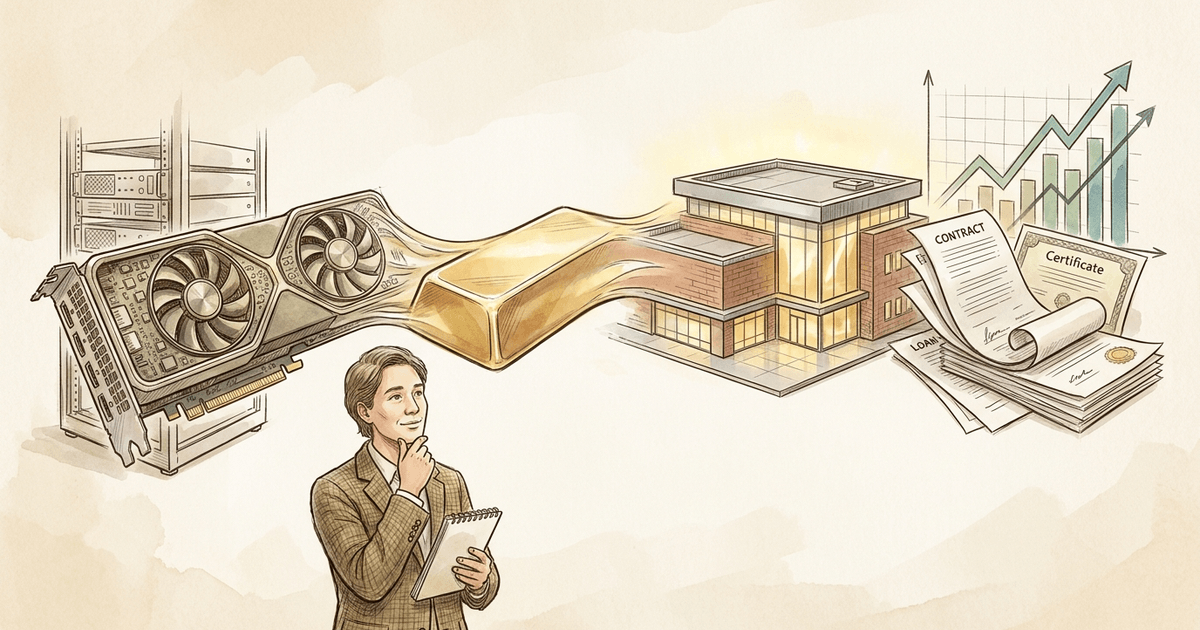
In the 2026 AI market, semiconductors like GPUs and ASICs are starting to take on a side they never had before. They are no longer just hardware (a part). They are beginning to act like gold, a store of value.
On top of that, they also behave like real estate that produces rental income, and in some cases the contracts behind them are being packaged into leveraged financial products.
AI infrastructure today has already entered a “third stage.”
flowchart LR
    A["Stage 1<br/>Part"] --> B["Stage 2<br/>Asset (real estate)"] --> C["Stage 3<br/>Financial product"]
    classDef s1 fill:#e2e8f0,stroke:#64748b,stroke-width:2px;
    classDef s2 fill:#dbeafe,stroke:#2563eb,stroke-width:2px;
    classDef s3 fill:#fef3c7,stroke:#d97706,stroke-width:2px;
    class A s1;
    class B s2;
class C s3;| Stage | Role | Nature |
|---|---|---|
| Stage 1 | A “part” that runs AI | Ordinary semiconductors and hardware, bought and sold by order. |
| Stage 2 | An “asset” that earns rental income (real estate) | Deployed in data centers and rented by the hour through the cloud, producing ongoing cash flow. |
| Stage 3 | Backed by collateral, guarantees, futures, and SPVs (financial product) | An asset that stores value, can be used as collateral, and is traded in futures. |
Against a backdrop of global supply limits and overwhelming demand, GPUs today are starting to hold their value, which gives them the character of a store of value (the “gold” property).
At the same time, lending them to AI companies produces ongoing cash flow (rental income, the “real estate” property). So they are treated as a hybrid asset that combines all three: store of value, collateral, and income.
Below I look calmly at the three key moves that support this “financialization” of infrastructure, the expansion into the leveraged loan market beyond it, and the risk it carries, with concrete news as reference.
1. Three currents behind “financialization and commoditization”
GPUs have become an asset that financial institutions can value as collateral, and a commodity whose price swings can be hedged. Behind that shift are three mechanisms that took shape entering 2026.
| Current | Example | Mechanism | Financial meaning |
|---|---|---|---|
| 1. Mass purchase with debt | CoreWeave ($CRWV) | Borrow heavily to buy GPUs in bulk, repay with rental income | Funding through leverage |
| 2. Asset valuation and default guarantee | Barkr x USDai | Insurance and appraisal that cover resale losses | Making collateral value objective |
| 3. Compute futures | CME x Silicon Data | Short future rental capacity to lock in price | Hedging price swings |
1. The debt-funded mass-purchase model (CoreWeave and others)
GPU-focused cloud providers, with CoreWeave ($CRWV) as the prime example, have built a model where they borrow huge sums from banks and private credit to buy GPUs in bulk, then repay with rental income from large customers. The company is reported to have secured another $8.5 billion in financing (DDTL 4.0) in March 2026.
2. The birth of asset valuation and default guarantees (Barkr and others)
GPUs turn over fast between generations, and their residual value is hard to read. For that, insurance that covers the resale loss on default has appeared (for example, the partnership between Barkr, which appraises assets, and USDai). This makes the hardware itself objectively valued, and makes it easier for financial institutions to set it as collateral.
3. Locking in income with a compute futures market (CME and others)
The biggest worry for a data center operator is the risk that “we bought GPUs with a huge sum, but a few months later the rental price falls and we can’t recover the investment.”
To solve this, CME Group, the world’s largest derivatives exchange, and Silicon Data, a GPU market intelligence firm, jointly announced the launch of a “Compute Futures” market.
How the futures hedge works
The moment an operator buys GPUs, it shorts “future GPU rental capacity” in the futures market to lock in the price. Even if the actual rental rate falls half a year later, the gain on the futures trade fully offsets that loss, so the operator can fix a minimum return on investment (ROI) before the servers even start running. With this, GPUs became a “commodity whose price swings can be hedged,” just like wheat or crude oil.
2. From GPUs to ASICs and power contracts (the SPV scheme)
This current is not limited to NVIDIA’s GPUs. The recent $35 billion framework (the AI XPV Platform) by Broadcom ($AVGO), Apollo ($APO), and Blackstone ($BX) means this wave of financialization has spread to custom chips (ASICs) and to data center power contracts.
A representative case is the deal for Anthropic. They do not pay out a huge amount of cash to buy chips themselves.
flowchart TD
    A["Investment firm (Apollo, etc.)"] -->|Raise money and set up| B["A 'box' (SPV)"]
    B -->|Buy up ASICs and equipment| C["Equipment and chips"]
    C -->|Lease| D["Anthropic (borrower)"]
    D -->|Pays future 'chip usage fees'| E["Investors (banks, etc.)<br/>Receive a stable yield (like a bond)"]
    classDef spv fill:#fef3c7,stroke:#d97706,stroke-width:2px;
    classDef borrower fill:#dbeafe,stroke:#2563eb,stroke-width:2px;
    class B,C spv;
    class D borrower;
Semiconductors are starting to be treated not as a “product you make and sell,” but as a “real-estate-like asset that produces cash flow in the form of future usage fees.” This structure brings benefits to everyone involved, so it is likely to keep expanding.
| Player | Benefit |
|---|---|
| NVIDIA and Broadcom | Can speed up customer adoption (sales). |
| OpenAI and Anthropic | Can secure huge compute without relying on cash on hand (equity). |
| Wall Street | Can open a new, huge infrastructure finance market (yield products). |
3. The peak of financialization: Morgan Stanley’s “leveraged loans and CLOs”
Now a final phase has begun, where this “real-estate-ized” AI infrastructure is packaged with even more advanced financial engineering, spreading and making the risk liquid.
According to the U.S. outlet The Information, Morgan Stanley has begun seriously proposing to clients that they use the “leveraged loan” market rather than the traditional bond market.
What a leveraged loan is:
A high-yield loan made to companies that are below investment grade (relatively higher risk). It is usually used for things like corporate buyouts (LBOs), but the move now is to repurpose it for AI infrastructure funding (companies that burn cash fast, like OpenAI, and emerging clouds like CoreWeave).
In fact, in a $3.1 billion leveraged loan deal for CoreWeave that Morgan Stanley led in May 2026 (funding to buy chips for OpenAI and Cohere), orders from investors poured in at more than $19 billion, about 6 times the amount offered. The yield was a high SOFR + 4.5%.
Investor orders rushed in at about 6x the amount offered
* The yield was a high SOFR + 4.5%.
Banks and securities firms do not keep these loans on their own books. They gather a large number of them, pool them, package (securitize) them into a financial product called a CLO (collateralized loan obligation), and sell it to investors around the world.
The structure of the U.S. leveraged loan market that The Information described can be laid out like this.
About two-thirds is held by CLO managers
According to S&P Global data, the U.S. public leveraged loan market has reached about $1.4 trillion, and CLO managers hold about two-thirds of it. They are now avoiding loans to “traditional SaaS companies,” whose growth is in question because of AI’s rise, and are actively shifting money toward “data center and AI loans” backed by long-term lease contracts with big tech companies.
(Source: The Information, “Morgan Stanley Pitches Clients on a New Market for Data Center Loans”)
4. Structural similarities to subprime (CDO), and a check on the risk
This financial chain, pushing toward “GPU -> gold -> real estate -> subprime (CLO),” has points in common with the structure of the 2008 subprime loans and their securitized products (CDOs), and at the same time it carries challenges specific to AI.
| Point | Subprime / CDO (2008) | AI infrastructure / CLO (2026) |
|---|---|---|
| What gets bundled | Home loans to individuals with low ability to repay | Loans to AI startups below investment grade |
| How it looks “safe” | Tranching turns part of it into AAA-rated products | Explained as “stable” thanks to long-term contracts with big tech |
| The assumption that breaks | ”Home prices never fall" | "The value of GPUs and AI demand will last” |
| Useful life of the collateral | Homes: 30+ years | Cutting-edge AI chips: depreciate very fast |
1. Securitization that bundles low-rated debt and makes it look “high quality”
In the subprime era, “home loans to individuals with low ability to repay” were pooled in bulk, layered by risk (tranching), and part of it was dressed up as a “safe, AAA-rated product” to sell to investors.
This AI CLO works the same way. “Loans to AI startups below investment grade” are blended in bulk and, through securitization, structured on the premise that “because there are long-term contracts with big tech companies, it is stable as an infrastructure investment.”
2. The collateral’s (GPU’s) overwhelming speed of obsolescence (useful life)
In the 2008 crisis, the system broke down when the premise that “home prices never fall” collapsed. The premise in AI infrastructure finance today is that “the value of GPUs and AI demand will last.”
But there is a mismatch in asset character here. While homes have a useful life of 30 years or more, cutting-edge AI chips depreciate very fast due to technological progress. “Whether the loan repayment schedule is properly set in parallel with the chip’s short useful life” is an important point for investors to check.
3. The effect of a slowdown in the “second derivative” of demand
What investors should watch is not AI demand vanishing entirely, but the growth rate of demand (the acceleration), that is, a slowdown in the second derivative.
The moment the market judges that the “speed of growth” in demand has gone flat, or has started to decelerate, stress builds on the financial structure of infrastructure companies that are built on excessive leverage.
If GPU rental prices were to turn downward, the following “chain of effects” could occur.
flowchart TD
    A["GPU rental prices fall / demand growth slows"] --> B["Cloud operators' income drops, cash flow worsens"]
    B --> C["GPU collateral falls underwater / SPVs and private credit go bad"]
    C --> D["Guarantors take losses / margin calls in the futures market"]
    D --> E["Through the $1.4 trillion CLO market, the impact spreads to the financial system"]
    classDef danger fill:#fee2e2,stroke:#dc2626,stroke-width:2px;
    class A,B,C,D,E danger;
Conclusion
Under the explanation that “it is safe because there are long-term contracts with big tech companies,” the market today is showing highly creative financial techniques (the “creativity” that a JPMorgan analyst points to).
In the short term, this financialization is an ecosystem that speeds up AI hardware procurement. But in reality, it is also a “structure that turns a physical asset, the semiconductor, into a paper asset through leverage,” and adding financialization and leverage brings its own danger. Advanced financial engineering is also a chain structure where risk can be amplified many times over.
If GPU rental prices were to turn downward, the risk could unwind through the financial system all at once: lower income for cloud operators, collateral falling underwater, losses at guarantors, bad debt at SPVs and private credit, and margin calls in the futures market. This is the risk of a “reverse spin.” When the supply-demand balance of these highly financialized semiconductors breaks, that reverse spin could become the trigger for an unexpected bubble collapse.
That is why we need to watch calmly, without excessive optimism, how that impact could unwind through the financial system.
From the viewpoint of an engineer, and of an investor in infrastructure, what matters is to analyze not just the lively “near-term demand (the first derivative)” in front of us, but also the risk management of the financial structure being built behind it.
Join the conversation on LinkedIn — share your thoughts and comments.
Discuss on LinkedIn