What API List Prices Don't Tell You About AI Subscriptions — OpenAI and Anthropic Usage Limits and Pricing Strategies, Seen by a Developer Who Runs AI All Day
Introduction: what I notice when I run AI all day
I develop with both OpenAI and Anthropic subscriptions. My style is to hand work to AI agents and leave them running all day.
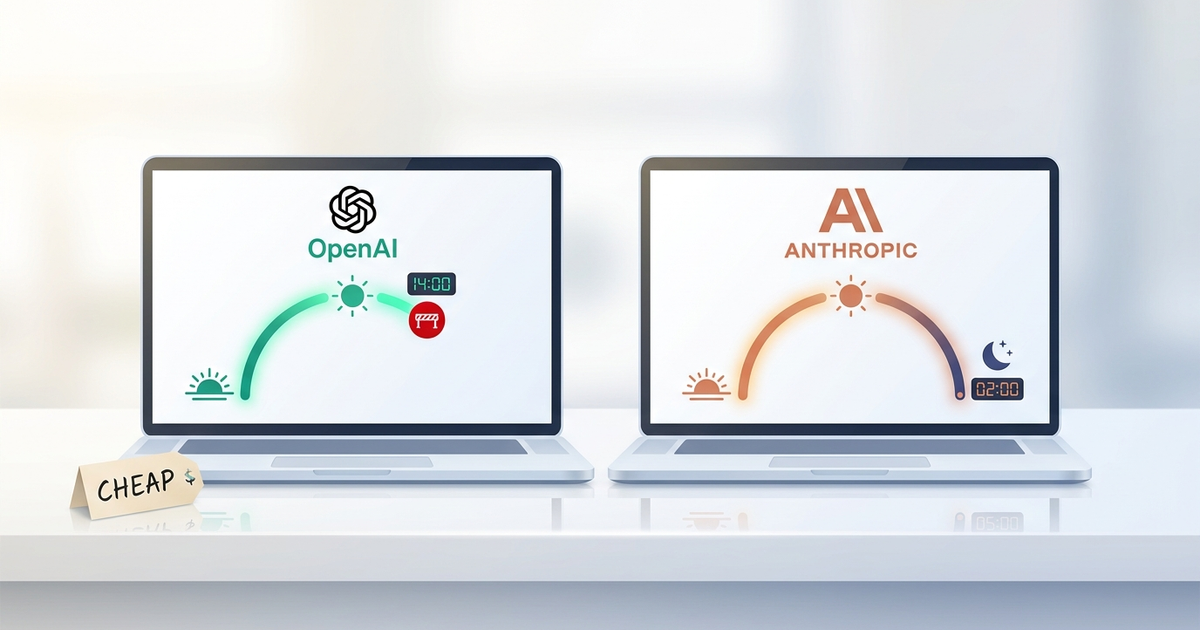
Doing this, I feel a clear difference in the usage limits.
| Model | What I experience |
|---|---|
| OpenAI GPT-6.1 Sol | Hits the limit quickly |
| OpenAI GPT-6 Astra | Hits the limit quickly |
| Anthropic Claude Fable 5.1 | Gone almost instantly |
| Anthropic Claude Opus 5.5 | Lasts a very long time |
When Codex (OpenAI) is working, I never know when the limit will come, so I have to keep an eye on it. With Opus 5.5, I can look away without worry.
Most of my work is fairly difficult. For example, I recently improved Google’s new EmbeddingGemma 2 into a video judgment model (Reflex-2). It is a new model that is not in the AI’s training data, but the work went smoothly with Opus 5.5.
Where does this difference come from? SemiAnalysis, a research firm focused on semiconductors and AI infrastructure, measured each company’s subscription limits in its report “Anthropic Subscriptions Offer 5x+ More Value Than OpenAI.” In this post, I first check my experience against that data, and then look at it from two sides:
- The developer and company side: how to choose a plan
- The vendor side: why the limits are so different
Checking with data: SemiAnalysis’s measurements
SemiAnalysis tracked the usage meter for each token type — input, output, cache read, and cache write — to find out how many tokens each plan really allows. It then compares plans by “API-equivalent value”: the usage up to the limit, priced at API rates.
The comparison is based on a typical agentic workload:
| Token type | Share |
|---|---|
| Input | 0.4% |
| Cache read | 96.6% |
| Cache write | 2.6% |
| Output | 0.3% |
Agents read the same code and documents again and again, so almost all tokens are cache reads.
How far each model goes on a $200/month plan
This order matches my experience well. Sol, Astra, and Fable hit their limits at around $2,000–3,000 of value. Only Opus 5.5 has a far larger allowance, about $11,700.
- Opus 5.5 gives about 5.6x the value of Sol. This is the “5x” in the report’s title.
- In tokens, the gap is about 2.8x (Sol about 10.2B, Opus about 28.6B). Sol has a lower API price, so the gap grows when converted to dollars.
- The report itself uses both “about 5x” and “about 4x.” The multiple depends on what you compare.
OpenAI cut its limits roughly in half
On September 29, 2026, OpenAI lowered the limits of its $200/month ChatGPT Pro 200 plan.
OpenAI also added a $500/month plan, but according to SemiAnalysis, its Astra allowance is only 21% more than the old $200 plan. Existing $200 subscribers keep the old limits until October 29.
The developer and company side: how to choose
What matters is how long it can run without someone watching
By API list price, OpenAI’s Sol is much cheaper than Anthropic’s Opus 5.5. But when you run agents on a subscription, in my experience the price per token is not what matters. What matters is how long the work can continue without someone watching it.
flowchart LR
    A["Small limit"] --> B["Work stops<br/>midway"]
    B --> C["Someone must check<br/>and restart it"]
    C --> D["The developer is<br/>tied to the screen"]
    E["Large limit"] --> F["Work keeps<br/>going"]
    F --> G["The developer can<br/>do other work"]
    classDef bad fill:#ffebee,stroke:#c62828,stroke-width:2px;
    classDef good fill:#e6f6f1,stroke:#10a37f,stroke-width:2px;
    class A,B,C,D bad; class E,F,G good;
Each time the limit stops an agent, a person has to check the situation and restart it. You meant to hand the work to AI, but your own time ends up tied to the AI. This is why I feel I cannot look away from Codex.
The harder the work, the more it matters to use a top model for a long time
Harder work needs stronger models. With something like EmbeddingGemma 2, a new technology the model has not learned, there is also more trial and error.
This is where the plan design of each company makes a difference.
| Point | OpenAI (Pro 200) | Anthropic (Max 20x) |
|---|---|---|
| Top model | Astra: limit at about $2,897 of value | Fable: limit at about $2,485 of value (up to 50% of the allowance) |
| Main everyday model | Sol: limit at about $2,084 of value | Opus 5.5: up to about $11,726 of value |
| Running all day | Every model tends to stop midway | Opus rarely stops |
On Anthropic, the top model Fable runs out fast, but Opus 5.5 below it has a large allowance, and you can keep working with Opus after Fable is used up. Being able to run difficult work on Opus 5.5 for many hours is the deciding factor for how I work.
What developers and companies should check
In my view, these are worth checking when choosing AI tools and plans:
- The API-equivalent value of the model you actually use: not the plan price or the API list price, but how much you can use that model before the limit.
- Your workload mix: agentic work is mostly cache reads, so limits affect it differently from chat-style use.
- Limits change without notice: SemiAnalysis recommends checking daily, because limits change with model updates and promotions. It even found a small A/B test where some accounts had limits about 20% lower.
The vendor side: pricing strategy
So why are the limits so different? The reason is the difference in revenue structure.
Anthropic: subscriptions are 10% of revenue but 40% of compute
According to SemiAnalysis’s Tokenomics Model, Anthropic’s subscriptions bring in about 10% of revenue but use more than 40% of its inference compute.
The gross margin on a subscription depends a lot on how much the user actually uses. Assuming a 92% API gross margin, SemiAnalysis estimates the following.
Running Opus 5.5 all day, as I do, must be a large loss for Anthropic. It still works because the API business, which is 90% of revenue, is very profitable.
But Anthropic is not subsidizing without limits. It keeps the top model, Fable, at a level where even full use leaves the margin near zero, and focuses the subsidy on its main model, Opus. When it cut API prices with Opus 5.5, it also raised limits by about 20% on Max and about 50% on Pro.
In my view, the generous Opus allowance is Anthropic’s investment in its subscriptions. It is a B2B-driven investment: get individual developers and power users settled into Claude, and lead their companies to API contracts. I also guess that, ahead of an IPO, it wants to secure support from developers.
OpenAI: a high share of subscriptions makes subsidies hard
OpenAI is said to depend on consumer subscriptions for a much larger share of its revenue than Anthropic. Losses on subscriptions would hit the whole company directly.
So instead of treating models differently, OpenAI cut limits across all plans, and made the “allowance per dollar” the same across plans.
Another point worth noting is how API price cuts and subscription limits interact.
| When | Change | Result |
|---|---|---|
| GPT-6.1 Sol launch | Cache-read API price cut by 50%; subscription limits unchanged | Sol’s API-equivalent value fell by about 30% |
| September 29, 2026 | Pro 200 limits cut by about half; $500 plan added | Sol’s API-equivalent value fell by over 50% in total |
If the API price goes down but the subscription limit stays the same, the value you get from the subscription goes down. It looks like a price cut from the API side, but on the subscription side it is effectively a price increase.
SemiAnalysis thinks OpenAI avoided a large backlash thanks to the DevDay announcements and the one-month transition period.
How the two strategies differ
flowchart TB
    subgraph OA["OpenAI"]
      O1["Revenue centered on<br/>consumer subscriptions"] --> O2["Subscription losses hit<br/>the whole company"]
      O2 --> O3["Limits cut evenly<br/>across all models"]
    end
    subgraph AN["Anthropic"]
      A1["~90% of revenue<br/>from enterprise API"] --> A2["API profit<br/>subsidizes subscriptions"]
      A2 --> A3["Large allowance focused<br/>on the main Opus model"]
      A2 --> A4["Top Fable model<br/>capped at 50%"]
    end
    classDef oa fill:#e6f6f1,stroke:#10a37f,stroke-width:2px;
    classDef an fill:#fbece6,stroke:#d97757,stroke-width:2px;
    class O1,O2,O3 oa; class A1,A2,A3,A4 an;
Still, Anthropic’s generous allowance may not last. SemiAnalysis expects Opus to get cheaper to serve, but also expects future higher tiers to come with lower limits. As a developer, I think it is better not to rely too much on today’s gap, and to keep watching how the limits change.
Conclusion
OpenAI’s cheaper API token prices catch the eye, but I think it is important not to choose by that alone, and instead to look at how many tokens a subscription really lets you use, and how fully you can put them to work.
References
Join the conversation on LinkedIn — share your thoughts and comments.
Discuss on LinkedInRelated Posts
Why AI Keeps Slipping Out of Control: What the OpenAI and Anthropic Incidents Show About the Difficulty of Containment
Reading the OpenAI and Anthropic IPOs Through an Investor Lens — Risks to Watch Before the Hype
