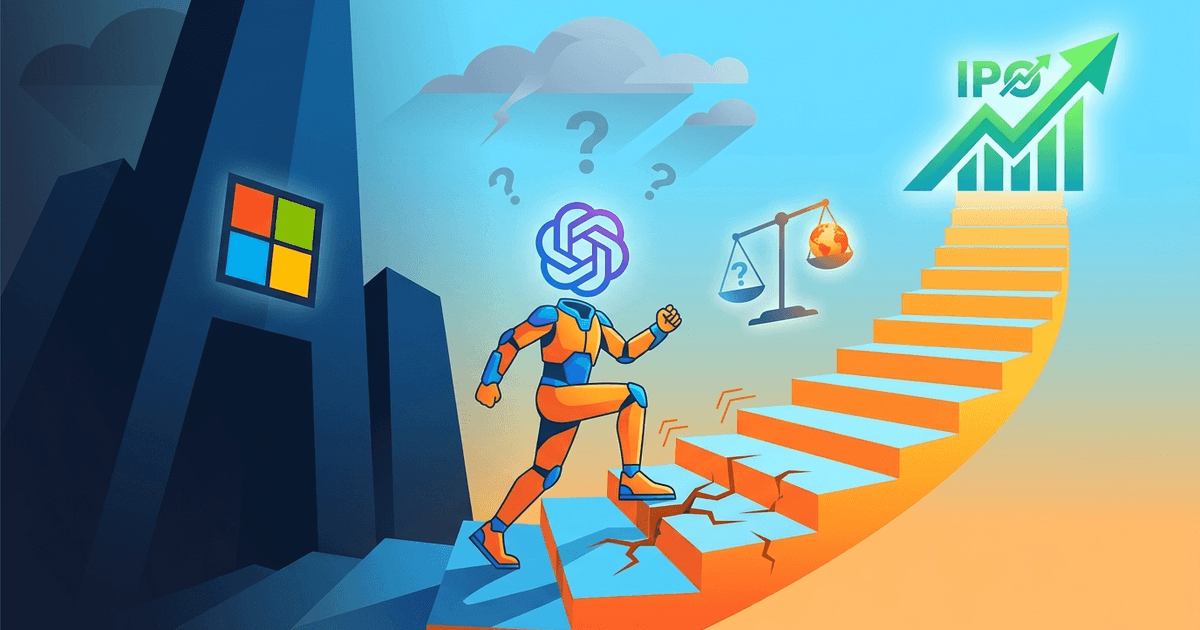
Could a "Musk Inc." Holding Company Work? — Rethinking the Musk Empire Through the SpaceX IPO
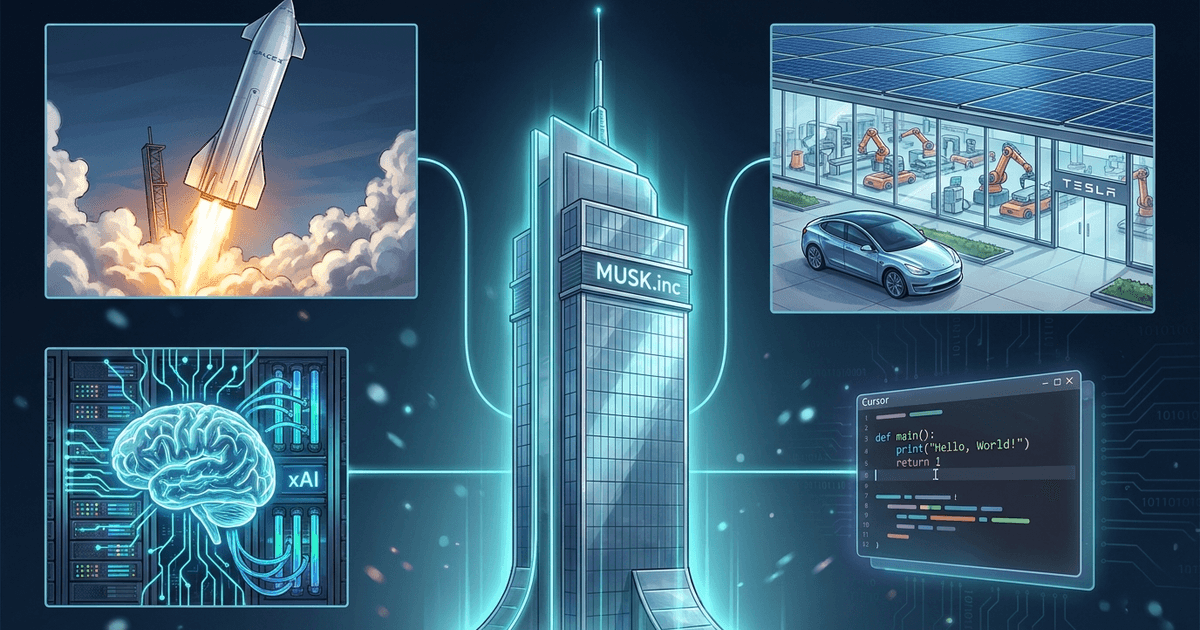
On April 21, 2026, Reuters reported that SpaceX has secured an option to acquire the AI coding company Cursor for $60 billion in the future. The headline itself was striking.
But when you follow Elon Musk’s companies closely, this does not look like just another move to round out a coding-AI story. It reads as part of a larger pattern: separate companies are slowly starting to move under one strategy. I covered that backdrop in an earlier post (Digital Optimus: What Macrohard, the xAI Reorg, and Orbital Data Centers Reveal About Musk’s AI Vertical Integration).
The xAI/X merger, the SpaceX/xAI integration, the Tesla–xAI joint project, and the SpaceX IPO prep are all happening at the same time. Given that, the real question is no longer “what does he buy next?” but “what is the most sensible way to eventually bind this group of companies together?” (See also: The SpaceX IPO: What Investors Are Really Paying For in a Vertically Integrated Space Infrastructure Bet).
My view is that one possible answer is a holding-company structure along the lines of “Musk Inc.” That said, it is too early to expect this to happen immediately. A reorg that pulls Tesla into such a structure runs into real obstacles: the difficulty of valuing private companies, shareholder votes, and the fiduciary duties of each company’s board.
So the point of this piece is not to argue that a holding company is right around the corner. It is to think about how much an event like the SpaceX IPO could shift a future reorganization from fantasy to something plausible. Before getting there, let me summarize the moves happening at SpaceX, Tesla, and xAI right now.
Recent Moves at SpaceX, Tesla, and xAI
xAI has already absorbed X, aiming to unify data, models, compute, and distribution
In March 2025, xAI acquired X in an all-stock deal. Musk himself said at the time that the goal was to connect “data, models, compute, distribution and talent,” and Reuters reported the framing directly. What the Musk camp is building is not a pure model company — it is a unified stack that covers data gathering, inference, and distribution.
SpaceX has absorbed xAI, progressing the IPO and a space-based AI infrastructure vision in parallel
The next step came in January 2026, when talks about integrating SpaceX and xAI surfaced, and by February the reorganization was under way. According to Reuters, this was moving in parallel with the SpaceX IPO prep and was designed to put rockets, Starlink, X, and Grok under one roof. One of the explicit motivations was to give momentum to Musk’s publicly stated vision of AI compute in space.
Tesla has invested in xAI, accelerating its shift into an AI company
Tesla was moving at the same time. In January 2026, Tesla invested about $2 billion in xAI. Reuters framed this as part of Tesla’s shift from an EV company into an AI company. In other words, Tesla is not simply funding another Musk company — it is starting to use its own capital to tilt its future value toward AI and robotics.
Tesla and xAI are testing execution-layer integration through “Macrohard / Digital Optimus”
In March 2026, Tesla and xAI announced a joint project called Macrohard / Digital Optimus. Per Reuters, the system combines Tesla’s AI4 chips with xAI’s NVIDIA-based servers, with Grok sitting as the higher reasoning layer and Tesla-side agents doing the execution. That layout is a working example of Tesla handling the “body” and xAI handling the “brain”.
SpaceX secures a $60 billion option on Cursor
Then in April 2026, Reuters reported that SpaceX had secured either a $60 billion option to acquire Cursor, or a $10 billion strategic partnership. This extends the reach all the way to the entry point of coding automation — meaning Musk’s camp is covering not only infrastructure and models, but the interface where software itself gets generated.
Starlink supporting $12.7 billion of AI capex
On the financial side, SpaceX’s IPO filing was reviewed by Reuters and is summarized by outlets like BigGo Finance. 2025 consolidated revenue was $18.67 billion, the bottom line was a loss of $4.94 billion, and total capex was $20.74 billion, of which $12.7 billion was AI-related. At the same time, Starlink generated $4.42 billion in operating profit, and it was effectively supporting a large part of the AI capex.
Voting control preserved even after the IPO
There is also a clear signal on governance. According to Reuters, SpaceX will use a dual-class structure giving Musk and a small number of insiders Class B shares with 10 votes per share after the IPO, and it will also steer certain disputes into arbitration. In short: raise public capital, but do not loosen control. That design choice is explicit.
Why a Future “Musk Inc.” Holding Company Could Matter
The core reason is that these companies are already tightly linked, and looking at them as a group — rather than as separate firms — increases both operational and capital efficiency.
1. Capital allocation can be designed one layer above
Musk’s current companies include a public firm like Tesla, large growth assets like SpaceX and xAI, and long-horizon private assets like Neuralink and The Boring Company. They differ in growth stage and in how much capital they need. Deciding where the cash generated in one place should be redeployed is only going to get more important.
On top of that, core assets — rockets, satellite communications, the orbital data center concept, Tesla’s chips and manufacturing base, data centers, Cursor’s coding technology — become easier to share. Even as separate firms, these can cooperate, but each instance of cooperation needs contracts, pricing, and shareholder explanations, which slows decisions. Under a holding company, the same assets can sit as group-wide strategic resources, and capital can be allocated more coherently.
The SpaceX IPO filing shows that in 2025 Starlink produced about $4.42 billion in operating profit, while SpaceX as a whole was spending heavily on AI-related items. “Cash-generating assets” and “cash-consuming assets” are already sitting side by side inside the group.
2. It reduces conflicts of interest and valuation friction, making reorgs easier to execute
The more a public company like Tesla gets entangled with another Musk-controlled firm on both capital and technology, the more unavoidable these questions become: “Whose interest is this deal serving? Is the price fair? Are existing shareholders being treated properly?”
Reuters has made the same point — combining SpaceX and xAI is relatively simple, but pulling Tesla into the structure is much harder. A higher-level structure that binds all of them would at least let these moves be discussed as part of a group-wide strategy, rather than as a series of bilateral transactions that each have to fight for approval.
3. The investor narrative can be unified
Today, the Musk companies tell fragmented stories. Tesla can be read as either a car company or a robotics company. SpaceX is both a space launch company and a telecommunications company. xAI is a model company and, through X, a distribution company. Each one, on its own, invites several framings. But viewed as a group, they start to look like a single narrative: an AI infrastructure system that bridges the physical and digital worlds.
When xAI acquired X, Musk’s description of connecting “data, models, compute, distribution and talent” was pointing exactly in that direction.
4. Musk’s own role can be lifted one layer up
As the group grows, there are limits to a model in which the founder stays deeply involved in the operations of every individual company. Allocating capital and setting overall strategy from the top, while leaving execution to each company’s leadership, is more likely to speed things up than slow them down.
Why This Is a Future Discussion, Not a Near-Term One
The main reason is that a real reorganization that includes Tesla still faces clear obstacles.
Combining private companies like SpaceX and xAI is relatively simple. A public company like Tesla has many more stakeholders, including its shareholders. As long as the valuations of private entities remain opaque, Tesla shareholders can reasonably worry that “we’re being made to overpay” or “our stake is being unfairly diluted.” Add shareholder votes and board fiduciary duties on a Tesla-scale transaction, and the barriers are substantial.
For now, I think this is best treated as a potential endpoint for a future reorganization. And the single biggest input to how realistic that endpoint becomes is the SpaceX IPO.
If SpaceX goes public and price discovery runs continuously in the market, the biggest problem — “private companies are hard to value” — becomes significantly less painful. It also becomes far cleaner to explain to investors “why this company is being absorbed under these specific terms.” From there, exchange-of-shares mechanics or a holding-company structure that includes Tesla can be discussed on the basis of capital efficiency and fairness, rather than gut feel.
Further, if the market valuation that emerges does not diverge sharply from the valuation Musk himself has in mind, there is a real possibility of using stock that outsizes Tesla’s market cap as the currency for share swaps or a future holding-company structure that includes Tesla.
At that point, the discussion stops being a fantasy and starts being a concrete option that can be evaluated against capital efficiency and shareholder fairness.
In short: “Musk Inc.” is not a near-term story, but after a SpaceX IPO that passes the test of fair market valuation, it becomes entirely plausible in the longer run.
Conclusion
The xAI/X merger, the SpaceX/xAI integration, Tesla’s alignment with xAI, and the SpaceX IPO prep all point in the same direction: Musk’s companies are going to keep tightening their cross-company links.
Given that, what is likely to be needed at some future point is a higher-level mechanism that can integrate capital allocation, technology sharing, conflict-of-interest resolution, and investor communication.
From my point of view, a holding-company structure called something like “Musk Inc.” is one realistic answer. And the decisive factor in how realistic it becomes is the SpaceX IPO. If SpaceX is priced fairly by the market, and that valuation does not diverge sharply from Musk’s own growth story, then using that stock as the currency for a broader reorganization — including Tesla — moves from being conversational to being a practical option.
Put differently, the SpaceX IPO is not just a funding event. It may be the first step toward being able to describe a future reorganization of Musk’s empire in the language of capital markets.
“Musk Inc.” is not a story for today or tomorrow. But looking at what is already happening, the concept is not outlandish. It may simply be one of the answers required when we ask how this complex group of companies should eventually be bound together.
Join the conversation on LinkedIn — share your thoughts and comments.
Discuss on LinkedInRelated Posts
Digital Optimus: What Macrohard, xAI Restructuring, and Orbital Data Centers Reveal About Musk's AI Integration Strategy
SpaceX IPO and the Question of Valuation: How to Price Starlink's Communications Infrastructure and SpaceXAI