Digital Optimus: What Macrohard, xAI Restructuring, and Orbital Data Centers Reveal About Musk's AI Integration Strategy
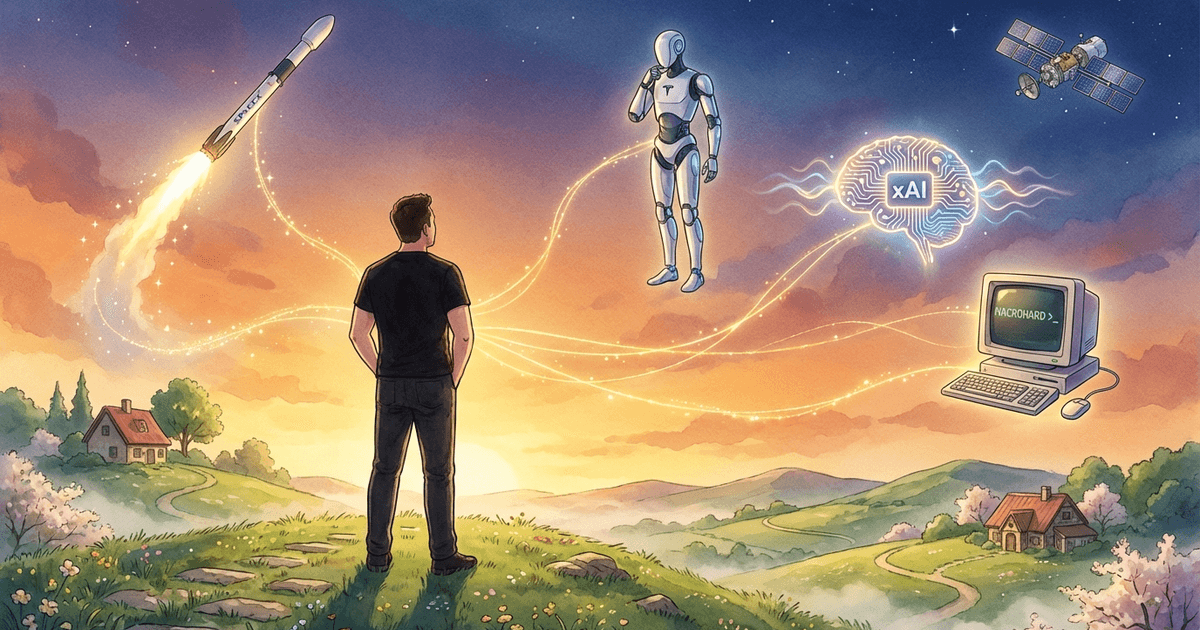
Tesla and xAI announced a joint project called “Macrohard” or “Digital Optimus.”
Reuters reported that Musk described the system as one that can “replicate the functions of a software company.” In this setup, xAI’s Grok serves as a high-level “navigator,” while Tesla-developed AI agents handle real-time execution. The system runs on a combination of Tesla’s AI4 chips and xAI’s NVIDIA servers.
Musk also posted on X the same day: “Macrohard or Digital Optimus is a joint xAI-Tesla project.”
What stands out is that Digital Optimus is not just another AI agent announcement. It takes Tesla’s real-time perception and control approach — developed for autonomous driving and robotics — and brings it into the domain of AI agents that work on a PC, with Grok directing from above. Following Reuters’ description, this is a system designed not to chat, but to execute work.
Looking back from this announcement, several previously separate developments start to connect: the Macrohard concept that had been in progress for some time, xAI’s restructuring, the departure of co-founders, the hiring of engineers from Cursor, the SpaceX merger, and orbital data centers.
This is my interpretation, but Musk appears to be building something beyond just an AI model. He seems to be assembling an AI-driven organization that operates with minimal human involvement, along with the AI infrastructure to support it — spanning models, execution layers, and compute resources.
What We Can Confirm
1. Digital Optimus Was Announced as a Joint Tesla-xAI Project
Musk introduced “Macrohard” or “Digital Optimus” as a joint project between Tesla and xAI. Reuters reported that Grok is positioned as a high-level “navigator,” while Tesla’s AI agents handle real-time screen, keyboard, and mouse interactions. The execution runs on Tesla’s AI4 chips combined with xAI’s NVIDIA servers.
2. Macrohard Was Not a New Idea — It Had Been in Development
According to Reuters, xAI had been working on Macrohard before this announcement, treating it as an AI project that could simulate the functions of a software company like Microsoft.
The U.S. Patent and Trademark Office records show that xAI filed a trademark for “Macrohard” in August 2025. So Digital Optimus is not an entirely new project. It appears to be the Macrohard concept evolving into a more concrete execution layer.
3. xAI Was Restructured in February, Followed by Continued Staffing Changes Focused on Coding
Reuters reported in February that xAI was reorganized after the SpaceX integration, moving to a four-division structure aimed at improving efficiency and execution speed at scale.
A subsequent Reuters article from March 13 reported that Musk was dissatisfied with xAI’s coding progress, continued to remove co-founders, and brought in engineers from Cursor.
Based on public reporting, strengthening coding and software execution capability was a central theme of the xAI restructuring.
4. Orbital Data Centers Were Cited as a Key Motivation for the SpaceX-xAI Merger
Reuters reported that SpaceX’s acquisition of xAI was intended to unify Musk’s AI and space ambitions, with orbital data centers listed as one of the primary motivations. The combined valuation was 250 billion for xAI. Reuters also connected this to expectations of a major SpaceX IPO.
Layer-by-Layer Analysis
Orchestration Layer
The first thing that stands out about Digital Optimus is that Grok is not positioned as a conversational AI, but as the upper command layer. In Reuters’ words, Grok is the “navigator” — deciding what to do, in what order, and when to invoke additional reasoning or information.
This aligns with a broader industry trend. Companies are moving beyond competing on single-model performance toward building upper layers that coordinate multiple AI agents — something like an AI OS for business operations.
Musk’s approach fits this context. That said, it is too early to call Grok an “AI OS.” What we can confirm is that in Digital Optimus, it is positioned as the orchestration layer.
Execution Layer
This is the most interesting part. Digital Optimus is not just a PC automation agent. What makes it notable is that Tesla’s real-time perception and control philosophy, developed for the physical world, appears to be carried over into the digital environment.
Reuters reported that Tesla’s AI agents process real-time screen video and input operations. This points in a different direction from conventional computer-use agents that make decisions based on static screenshots, one step at a time.
From this perspective, while it may be premature to call Digital Optimus “FSD for PCs,” it does look like a prototype of a hybrid design where edge-side processing handles immediate decisions while cloud-side processing handles higher-level reasoning and context. The combination of AI4 and NVIDIA servers announced in this release supports that reading.
Organization and Talent Layer
The timing of xAI’s restructuring and the staffing changes focused on coding also look different when viewed through the lens of Digital Optimus.
If Musk is serious about building “a company where AI does the work instead of humans,” what he needs is not just impressive conversational performance. He needs the ability to write code, use tools, and carry out actual work. From that angle, the fact that xAI’s restructuring centered on rebuilding coding capability makes a lot of sense.
Of course, I cannot say that the entire xAI restructuring was motivated by Digital Optimus. But looking back now, the restructuring may not have been simple organizational turmoil. It may have been a shift in emphasis from conversational AI to execution-capable AI.
Compute Infrastructure Layer
This is where orbital data centers become relevant. Reuters cited orbital data centers as one of the reasons for the SpaceX-xAI merger. At the same time, Reuters noted that orbital DCs face significant technical challenges: radiation damage to chips, thermal management in vacuum, maintenance of failed equipment, and communication latency with the ground.
If future compute infrastructure extends beyond terrestrial data centers to include distributed remote resources and orbital assets, it would make more sense to handle latency-sensitive tasks at the edge and offload heavier reasoning and context processing to the cloud.
The AI4 and NVIDIA server split in Digital Optimus can be seen as a small-scale prototype of that idea. Today, the processing is split between edge and cloud on the ground. In the future, it could be split between ground and orbit. Seen this way, Digital Optimus’s design and the orbital DC concept look naturally compatible. This is speculation, but the xAI restructuring may contain early groundwork for that direction.
My Take
I think Digital Optimus is not just another AI agent announcement. It is the news that finally gives a coherent meaning to Musk’s recent series of moves.
Macrohard alone could have been dismissed as branding. The xAI restructuring alone could have been explained as addressing competitive weakness. The SpaceX merger and orbital DC talk could have been filed away as long-term dreams.
But with Digital Optimus, those things look different. Grok directing from above, Tesla-style real-time AI actually watching the screen and acting, AI4 and NVIDIA servers sharing the workload. At this level of specificity, the idea that Musk is building an AI-driven organization that operates with minimal human involvement, plus the AI infrastructure to support it, starts to look quite realistic.
To put it another way, even if we stop short of calling this “complete vertical integration,” it at least looks like an effort to connect edge AI, cloud AI, and future large-scale compute resources under a structure centered on Musk’s own companies.
In that sense, Digital Optimus is not a standalone product announcement. It is the news that Musk’s recent scattered moves are starting to form a line.
Alternative Perspectives
1. This Is Just a Coding-Capability Rebuild, Not a Grand Strategy
A more cautious reading is that xAI’s restructuring is fundamentally about addressing competitive gaps, and connecting it to orbital DCs and a fully AI-run organization is a stretch. What Reuters emphasized most strongly was efficiency improvements, coding capability rebuilds, and co-founder departures — practical management challenges.
2. Digital Optimus Is Still at the Vision Stage
The announcement is interesting, but we do not yet know how effectively AI4 and NVIDIA servers can reliably handle large-scale white-collar work. Based on public information, what was shown was a directional concept. It is too early to conclude that this can “replace an entire company with AI.”
3. Orbital Data Centers Face Very High Implementation Barriers
Orbital data centers are part of Musk’s long-term vision, but the challenges — radiation, thermal management, maintenance, latency — are serious. Claiming that “Digital Optimus was designed for orbital DCs” goes too far. It is more accurate to say that Musk’s long-term infrastructure vision and the distributed AI design shown in Digital Optimus happen to be compatible.
Summary
What makes this news significant is that Digital Optimus has begun to give coherent meaning to what previously looked like separate moves by Musk — Macrohard, the xAI restructuring, the SpaceX merger, and orbital data center plans.
Based on publicly available information, Musk appears to be building more than just an AI model. He seems to be pursuing vertical integration of an AI-driven organization and supporting infrastructure — from edge AI and cloud AI to future large-scale compute resources.
Digital Optimus is the first time this vision has become visible from the execution layer side. That is what I find significant about this announcement.
Join the conversation on LinkedIn — share your thoughts and comments.
Discuss on LinkedInRelated Posts

SpaceX IPO and the Question of Valuation: How to Price Starlink's Communications Infrastructure and SpaceXAI
Could a "Musk Inc." Holding Company Work? — Rethinking the Musk Empire Through the SpaceX IPO