The Era of White-Collar Work Redesign, as Shown by AWS and Meta — How Should We Work and Invest in the Structural Shift from Labor Costs to AI?
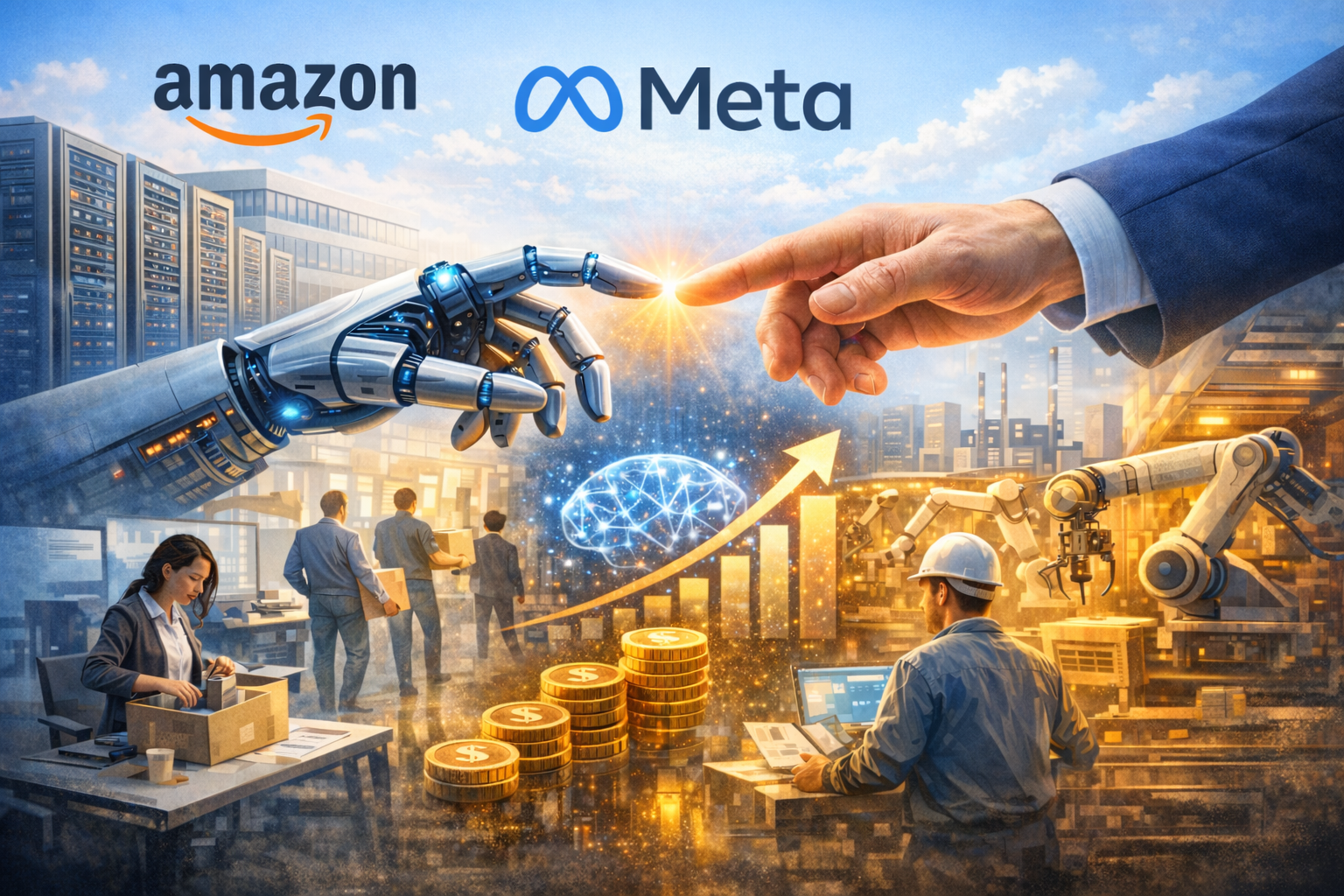
The Information has reported that AWS is accelerating the use of internal AI agents in areas such as sales, first-line technical responses, and partner support.
At Meta, reports indicate that CTO Andrew Bosworth is now leading an initiative to strengthen internal AI adoption across the company.
Meanwhile, software stocks including Salesforce have been sold off sharply on fears that AI could undermine existing business models.
These stories may seem unrelated at first glance, but I believe they are all manifestations of the same structural shift.
That shift is this: companies are beginning to replace routine white-collar work — traditionally a variable cost in the form of payroll — with compute resources and in-house AI, which behave more like fixed costs.
If this view is correct, what is happening goes beyond simple efficiency gains. White-collar work itself is being redesigned, and at the same time, the revenue models of SaaS companies and the layers of value that capital markets reward are starting to change.
In this post, I want to use the moves at AWS and Meta as a starting point to sort out which jobs are easy to replace with AI and which are likely to remain, and then consider how we should work and invest going forward.
What Is Happening
On the AWS side, the visible trend is an effort to replace some white-collar functions — sales, business development, first-line technical support, and partner coordination — with AI agents.
Amazon CEO Andy Jassy has stated publicly that the corporate workforce is expected to shrink over the coming years as generative AI and agents become widespread. Amazon’s official communications also explain that generative AI is already being used broadly for internal operations, customer interactions, product detail generation, and demand forecasting. This is not just an “AI experiment” — it is a move that is starting to reshape the cost structure of corporate operations.
On the Meta side, Bosworth has been reported to lead Meta’s internal AI adoption initiative. Reuters has also reported that Meta is being forced to rethink its workforce composition and the nature of work itself, under the weight of its AI investments. What AWS and Meta share is that they are not just selling AI as a product to customers — they are embedding it deeply into their own operations.
And in the markets, a phenomenon being called the “SaaS-pocalypse” is unfolding.
On March 24, Barron’s reported Salesforce down roughly 6.1%, MarketWatch reported IGV down about 4.3%, and HubSpot, Atlassian, and others also fell sharply. Reuters reported that as early as February, U.S. software stocks had lost roughly $1 trillion in market cap in a single week on AI disruption fears.
This should be seen as the market beginning to seriously price in how AI could damage existing SaaS models.
Which Jobs Are Easy to Replace
Taking the AWS and Meta developments as a starting point, let us think about which jobs are most vulnerable to AI replacement.
The jobs most likely to be replaced are those where the answer already exists somewhere in existing documents, the format is mostly predetermined, and the work can proceed without anyone taking final responsibility.
Even tasks that appear intellectual on the surface may in practice consist of searching, organizing, summarizing, transcribing, and providing standardized responses from existing information. These are the functions that will lose importance first.
In terms of work patterns, examples include:
- Gathering, summarizing, organizing, transcribing, and updating information
- Knowledge base searches and standard responses
- Application checks, first-pass reviews, and rule matching
- Lead screening, prioritization, and case routing
- Post-meeting record updates, follow-ups, and internal handoffs
- Proposals and explanations that merely combine existing materials
- Standardized report generation and internal briefing drafts
- Number aggregation, variance extraction, and template-based reporting
- FAQ-type internal and external support
- Manual-based reviews, confirmations, and registration tasks
At the job title level, the roles that fall into this zone include:
- Sales operations and administrative support
- Sales Ops
- Initial contact in inside sales
- Standard product explanations by junior pre-sales engineers
- Partner review and application processing
- Accounting operations
- HR operations
- General affairs and procurement operations
- PMO assistants
- Document-heavy junior consultants and analysts
For example, in accounting, this means invoice matching, expense report checks, payment reconciliation, and maintaining outstanding payables/receivables lists.
In HR, it means attendance tallying, leave balance management, evaluation form collection, and onboarding/offboarding process tracking.
These are important tasks, but the rules and formats are well defined, making them easy to put on AI.
The key point here is that it is not “thinking work” that disappears — it is “work that merely organizes existing information and returns it” that thins out first.
The AWS case is a very clear concrete example of this general pattern.
AI agent adoption is advancing in sales, first-line technical responses, and partner-related work, and Amazon company-wide is using generative AI broadly for internal tasks like demand forecasting, customer support, and product information generation.
Which Jobs Are Hard to Replace
Conversely, the jobs that remain are those that involve responsibility, negotiation, design, and physical implementation.
In terms of work patterns:
- Final decisions that carry accountability
- Negotiations involving stakeholder alignment
- Upstream design — shaping solutions from ambiguous requirements
- Work that touches real-world equipment, facilities, and operations
- Exception handling and crisis response
- Final judgment on legal, audit, and risk matters
- Redesigning work processes after AI is introduced
At the job title level:
- Large-account sales / Strategic Account Executive — price negotiation, trust building, internal and external political alignment, closing long-term contracts
- Business unit heads / Division leaders / Executive officers — final decision-making, bearing accountability, organizational restructuring
- Upstream consultants / Business transformation leads — organizing ambiguous on-the-ground requirements and redesigning entire workflows
- Senior Solution Architects / Enterprise Architects — not standard explanations, but holistic design that accounts for customer-specific requirements, constraints, and exceptions
- General Counsel / Internal Audit / Chief Compliance Officers — final approvals, risk judgments, regulatory engagement
- Finance leaders under the CFO — accounting policy decisions, provisions, audit responses, cash flow management as final responsibilities
- Data center engineers / Power, cooling, and facilities engineers — physical implementation, incident response, capacity planning
- Field maintenance / Field engineers / Plant operations — hands-on work with high exception frequency
- AI implementation leads / AI Product Owners — not just deploying AI, but redesigning business processes after deployment
The point I want to make is this: the people who remain are those who can use AI as a tool for information processing, think through the final judgment themselves, and take responsibility, navigate ambiguity, and move things in the real world.
What Does the SaaS-pocalypse Mean
The SaaS-pocalypse is not the main topic of this post. I see it as a market-price reflection of the disappearance of routine white-collar work.
When AI replaces white-collar tasks, the first area to feel the impact is seat-based SaaS. The reason is simple: its revenue model was premised on “people continuing to interact with screens.”
First, headcount reductions directly reduce seat-based billing. The era in which corporate growth automatically translated into more employees and more SaaS seats is eroding with AI adoption.
Second, if AI agents are doing the work, the relative value of human-facing UI declines. SaaS products optimized for humans looking at screens lose their edge in a world where agents interact directly with APIs and data layers.
Third, hyperscalers may begin absorbing — and agent-ifying — functions that SaaS providers have traditionally owned.
The AWS case is exactly this kind of signal, showing that some sales support, technical responses, partner management, and lead qualification could be absorbed into the cloud platform layer.
In this context, the individual stock declines on March 24 take on meaning, and Reuters’ report on the roughly $1 trillion loss in software stocks in early February also serves as useful background.
How to Think About This as an Investor
The reason I bring up investment here is that if companies are indeed replacing routine white-collar work — shifting from variable labor costs to fixed costs in compute and in-house AI — then identifying who benefits from that shift serves as evidence for the structural change itself.
The most obvious beneficiary is AI infrastructure. Data centers, power, cooling, grid, and networking all see increased demand as white-collar work becomes more fixed-cost. In fact, Global X’s DTCR posted a one-year return of 28.88% as of December 31, 2025, outperforming SPY’s 17.73% over the same period. At a minimum, capital was clearly flowing into the data center and digital infrastructure theme.
Next are vertically integrated AI platforms. By vertical integration, I mean companies that control multiple layers — data centers, compute, proprietary chips, models, delivery infrastructure, business applications, and customer touchpoints.
The prime examples are Google and Amazon. Microsoft is important for its Azure and enterprise business strength, but its AI model layer relies more heavily on external partners, giving it a somewhat different character.
Google has publicly stated its commitment to a full-stack approach to AI, and Amazon is bundling its own chips, model offerings, AI platform, and operational deployment on AWS. This group controls not just the top layer of AI, but the computing resources underneath.
They are structurally stronger than SaaS companies. This is both an investment thesis and a signal of where the center of enterprise value is shifting.
Conclusion — What Should We Do
Companies have begun replacing routine white-collar work — shifting from variable labor costs to fixed costs in compute and in-house AI.
In this shift, the first jobs to lose importance are those that organize and return information. The jobs that remain are those involving accountability, negotiation, design from ambiguous requirements, and moving physical equipment and operations in the real world.
The same logic applies to investment. Software that depends on humans interacting with screens is structurally weaker than the computing resources that power AI and the vertically integrated platforms that bundle multiple layers together.
There are two things we should be doing.
As workers, we need to move from “organizing, transcribing, and providing standard answers” to using AI as a tool for information processing and then thinking for ourselves — taking on responsibility, negotiation, design, and physical implementation.
As investors, we need to read the flow of capital moving toward the infrastructure that AI requires and the companies that control it end-to-end.
AWS and Meta are not just layoff stories. They are companies that have begun redesigning white-collar work itself.
The question going forward is not “Can you use AI?” It is this: Is your work merely information processing that AI can easily replace, or does it include design, negotiation, accountability, interpersonal judgment, and physical work that only humans can do? Being able to make that distinction is what will matter most in how we work and invest from here.
Join the conversation on LinkedIn — share your thoughts and comments.
Discuss on LinkedInRelated Posts

How I See Meta's AI Strategy as an Investor — Business Realignment, Massive Capex, and the Value of Data Center Assets

SpaceX IPO and the Question of Valuation: How to Price Starlink's Communications Infrastructure and SpaceXAI