OpenAI's Independence Strategy and the Path to IPO: 'Revenue Gross-Up' Concerns from the Microsoft Partnership Amendment, and an Investor View
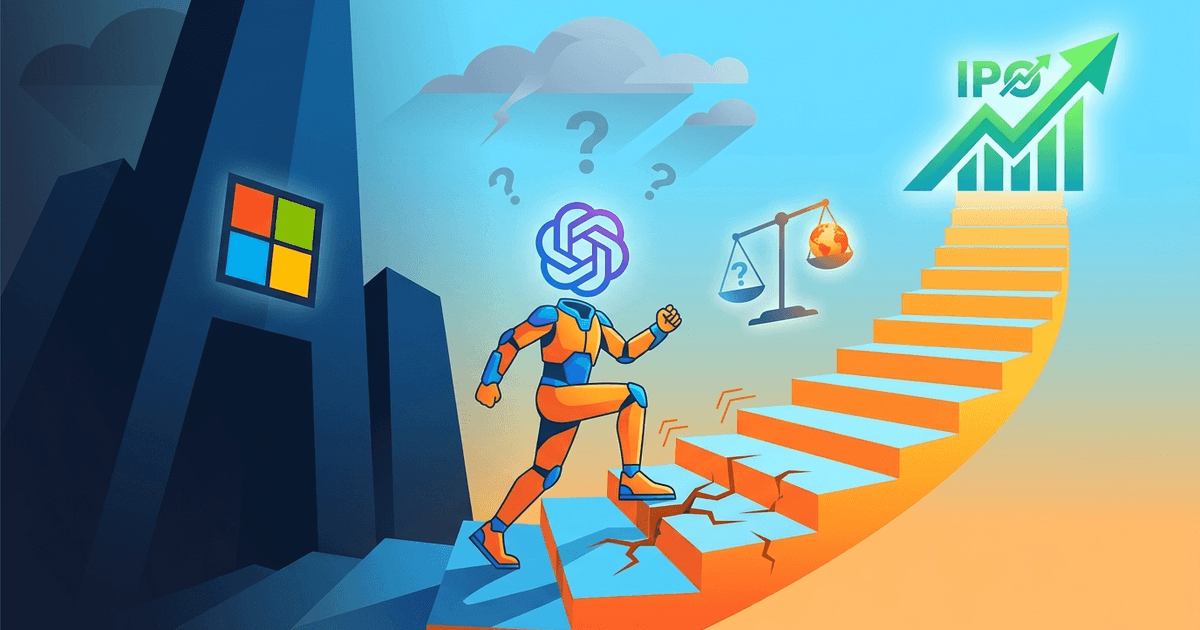
OpenAI announced on March 31, 2026 that it had closed $122 billion in committed capital, putting its post-money valuation at $852 billion.
On the surface, OpenAI looks like the defining growth company of the AI era. But as an investor, what matters is not just model performance or the ChatGPT brand. The more important question is how OpenAI is organizing its revenue, contracts, compute, and litigation risk on the way to an IPO.
In this post I look at four recent moves — the Microsoft partnership amendment, the push into advertising, the shutdown of Sora and other side bets, and the Musk lawsuit — through that investor lens.
1. The end of Microsoft exclusivity and the move to other clouds
OpenAI ending its exclusive relationship with Microsoft and expanding to AWS and other clouds is not only about giving the company more operational freedom. In my view, what investors should watch most carefully is the change in how revenue will be presented that comes with this shift.
Key terms of the amendment
Microsoft and OpenAI announced the new terms on April 27, 2026. The main points:
- Microsoft remains OpenAI’s main cloud partner, but OpenAI can now serve all of its products to customers on any cloud
- Microsoft’s IP license to OpenAI continues until 2032, but is no longer exclusive
- Revenue-share payments from Microsoft to OpenAI end
- Revenue-share payments from OpenAI to Microsoft continue until 2030, but with a cap
Reuters reports that the change ends Microsoft’s exclusive sales rights and makes it easier for OpenAI to partner with Microsoft’s competitors, including Amazon.
TechCrunch previously reported that OpenAI had been paying Microsoft 20% of its top-line revenue.
Strategic upside for OpenAI
Recognition as an independent platform
OpenAI is no longer seen as a feature inside Microsoft. It can now be evaluated as an independent platform that runs on AWS, Google Cloud, Oracle, and others. This matters for the valuation multiple at IPO.
Fit with agentic AI
AWS and OpenAI are jointly building a Stateful Runtime Environment on Amazon Bedrock that uses OpenAI models. This is the kind of environment AI agents need to keep context and work state across multiple tools and data sources.
Reduced dependence on Microsoft
Being able to run not only on Azure but also on AWS and other clouds matters for compute supply, enterprise sales, and pricing leverage.
Investor view: from net to gross revenue accounting
This is the single most important checkpoint for investors.
Until now, OpenAI was strongly tied to its Microsoft contract. Reports say OpenAI was paying Microsoft 20% of its revenue.
Under that prior structure, Microsoft took 20% of OpenAI’s own ChatGPT and API revenue, while sales through Azure OpenAI Service were booked by Microsoft as the primary seller, with about 20% returned to OpenAI. Either way, OpenAI’s reported revenue was constrained by the 20% rule.
After the amendment, Microsoft’s exclusive sales rights end and OpenAI can sell its products on AWS, Google Cloud, and other clouds.
If OpenAI sells its API directly through these clouds and books the full customer payment as its own revenue, the structure shifts from “only 20% lands at OpenAI” to “the full customer payment shows up as OpenAI revenue.”
In other words, even if real demand stays the same, simply changing the channel of sale could make OpenAI’s top line look much larger. That has a big effect on IPO valuation.
For Anthropic too, Reuters has pointed out that the difference between gross and net accounting makes it hard to compare AI company revenues.
So if OpenAI’s revenue grows quickly from here, the first question for investors is not “did usage really go up?” but “did the definition of revenue and the channel structure change?” If you miss this, you risk treating optical growth from the end of the 20% rule and a shift to gross accounting as if it were real demand growth.
2. The advertising push and the pull toward a high-margin model
OpenAI is also moving forward with advertising.
Reuters, citing Axios, reports that OpenAI projects ad revenue of $2.5 billion in 2026, $11 billion in 2027, and $100 billion by 2030.
At the same time, Digiday reports that the CPM for ChatGPT ads has fallen from around $60 at launch to about $25, and in some cases close to $15.
Advertising is structurally attractive for OpenAI. API and inference services cost more compute as usage rises. Advertising, if it works, could move toward the kind of high-margin model that Google and Meta have.
To justify a high IPO valuation, OpenAI needs to be evaluated not as a pure API company but as a high-margin platform with a direct consumer touchpoint. From that angle, advertising is an important card.
Investor view
Still, the advertising business is in an early phase.
The fact that CPMs are falling and inventory is limited suggests the platform is not yet easy enough for advertisers to use at scale.
Pricing future ad projections directly into the valuation is too early. For ads to become a real revenue pillar, OpenAI needs:
- Enough inventory
- Strong targeting
- Proper measurement
- Brand safety
- Ad placements that do not break the user experience
For now, OpenAI’s ad business is better seen as an option that supports a future margin story for the IPO, rather than a finished high-margin model.
3. The Sora shutdown and reorganization toward monetizable areas
OpenAI seems to be concentrating resources on areas that are easier to monetize.
According to OpenAI’s help page, the Sora web and app experiences end on April 26, 2026, and the Sora API ends on September 24, 2026.
At the same time, OpenAI is strengthening its enterprise business. In its enterprise strategy note on April 8, 2026, OpenAI said enterprise revenue already accounts for over 40% of total revenue and is on track to match consumer revenue by the end of 2026.
Why this is rational for OpenAI
Video generation is technically interesting, but it consumes a lot of GPU capacity and takes time to monetize. Codex and enterprise AI agents, by contrast, can fit into a company’s existing workflows and are easier to charge for.
If OpenAI is preparing for an IPO, it is natural to focus on the areas that are easier to monetize.
Investor view
The reorganization is reasonable. But putting too much weight on short-term profitability can also cut off future technology options.
Is the Sora shutdown a simple product cleanup, or a retreat from a high-cost area? Is the reshaping of the science and research teams an efficiency move, or a pullback from long-term R&D? These need to be judged over time, watching talent flow, research output, and the growth of the enterprise products.
4. The Musk lawsuit — a governance risk that could shake the IPO
The lawsuit with Elon Musk is a major risk for OpenAI’s IPO.
Reuters reports that Musk is seeking $150 billion in damages from OpenAI, Sam Altman, Greg Brockman and others. The center of the case is the claim that OpenAI moved away from its founding nonprofit mission and pursued for-profit deals such as the Microsoft partnership. Reuters reports the figure as $150 billion, while the Guardian reports more than $134 billion. The numbers differ between outlets, but both are very large.
OpenAI’s position is that Musk left OpenAI on his own, then started xAI, and is now using litigation to slow down a competitor.
Investor view
This case is not just a fight between founders.
OpenAI’s valuation is supported by these assumptions:
- It can grow as a for-profit business
- It can eventually IPO
- Investors can receive economic returns
The Musk lawsuit pushes back on these assumptions by asking, “shouldn’t OpenAI still be bound by its nonprofit mission?”
It is too early to say the case will fully block an IPO. But for investors, this litigation is one of the larger concerns on the board.
Summary
The end of Microsoft exclusivity gives OpenAI much more freedom. At the same time, if the way revenue is recorded changes, the top line could look bigger than the underlying demand.
Advertising creates an expectation of a high-margin model, but the business is still in an early phase.
The Sora shutdown and the reshaping of some research areas show a focus on monetizable work, but it is worth watching whether long-term technology options are being trimmed too far.
And the Musk lawsuit is a risk that touches OpenAI’s governance itself.
In looking at OpenAI’s IPO, what matters is to see clearly where the revenue comes from, how it is recorded, and what risks remain. From my view, that is the most important thing for investors to check.
Join the conversation on LinkedIn — share your thoughts and comments.
Discuss on LinkedInRelated Posts
Reading the OpenAI and Anthropic IPOs Through an Investor Lens — Risks to Watch Before the Hype
Amazon and Microsoft's Strategic Rivalry Over OpenAI — The Stateful vs Stateless Design Battle