Amazon and Microsoft's Strategic Rivalry Over OpenAI — The Stateful vs Stateless Design Battle
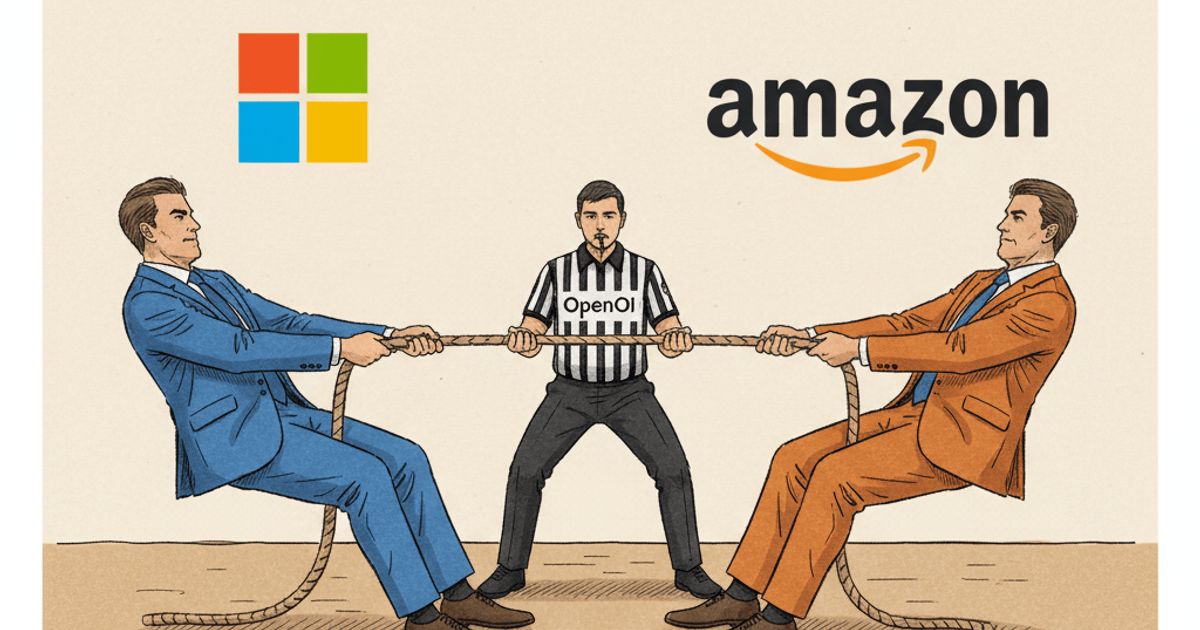
OpenAI and Amazon Web Services (AWS) have announced a new collaboration centered on “stateful” execution environments for AI agent development (AWS News Blog, 2026).
Meanwhile, the relationship between OpenAI and Microsoft remains strong, with a clear boundary: the “stateless API” — the general-purpose model access layer — is exclusively hosted on Azure.
In this article, I first lay out the facts confirmed through public sources, then share my analysis of the strategic dynamics likely to unfold.
The Facts: What Public Information Tells Us
Stateless API Is Exclusively Hosted on Azure
OpenAI and Microsoft’s joint statement explicitly names Azure as the exclusive cloud provider for “stateless OpenAI APIs.” General-purpose model access APIs are consolidated on Azure for hosting purposes.
Notably, OpenAI’s collaborations with third parties — including Amazon — are described as “expected,” with stateless API calls from those collaborations still being hosted on Azure (OpenAI official announcement).
OpenAI and AWS Are Jointly Building a Stateful Runtime
As a foundation for running AI agents on AWS, the two companies are co-developing a stateful runtime — an execution environment that maintains state across interactions (AWS News Blog, 2026).
OpenAI Also Offers Open-Weight Models (gpt-oss)
OpenAI provides gpt-oss (open-weight models) that teams can deploy and customize on their own infrastructure.
These models are also available on AWS, leveraging Amazon’s custom silicon (Trainium) among other capabilities.
Custom Models Through Amazon–OpenAI Collaboration
OpenAI and Amazon have described plans to offer a “stateful runtime” on AWS that enables custom AI agents capable of maintaining enterprise context — business rules, conversation continuity, and operational workflows. However, the specifics of model optimization and training methodologies remain undisclosed.
Microsoft Stock Decline and Investor Concerns
Following Microsoft’s earnings report in late January 2026, the stock dropped approximately 10% (Reuters, 2026). Cloud growth expectations and concerns about the burden of AI-related capital expenditure were cited as contributing factors.
My Analysis: Two Giants Competing for OpenAI’s “Fruits”
What follows is my interpretation. It may prove incorrect, but based on the public record, the following strategic picture emerges.
Microsoft Holds the “Front Door” to General-Purpose APIs
The arrangement where stateless APIs are hosted on Azure means, in practical terms, that Microsoft is well-positioned to capture revenue from general-purpose model usage — models like ChatGPT 5.2.
For standard use cases — users asking questions through chat, developers calling APIs for general-purpose tasks — Microsoft maintains a strong revenue position.
Amazon Builds Value Through “Stateful” Enterprise Context
As AI agents mature, the emphasis shifts from simple question-and-answer interactions to enterprise-specific workflows: procedures, permissions, audit trails, and exception handling. The contextual layer that maintains and operates on business logic grows substantially in importance.
AWS’s emphasis on “stateful runtime” is, in my view, strategically sound for this reason. What stands out is that Amazon appears to be pursuing not the model itself, but the platform for safely running agents embedded in business operations. If AWS can claim the operational layer above the model, the business opportunity is substantial — even if the model’s entry point remains on Azure.
The Custom Model Possibility
While the possibility of OpenAI and Amazon co-developing custom models has been suggested, the details — what data is used and how — naturally remain undisclosed.
That said, as a general principle, the more enterprise AI agents deliver results, the greater the need for data governance, permission structures, system integration, and audit capabilities.
Here is a hypothesis: OpenAI designs custom models for Amazon from the ground up — purpose-built for agent workloads running on AWS. These models could power enterprise-specific AI agents that run entirely on AWS, bypassing Azure. This would allow Amazon to capture the full revenue stream.
If this structure materializes, it could represent a direct challenge to Microsoft’s stronghold and would align with what may be the core strategic objective of this partnership.
Not a “Loophole” — A Consistent Division, but With Tension
I would characterize this arrangement not as a loophole, but as a division of territory that stays within contractual boundaries.
- Stateless API (general-purpose): hosted on Azure — Microsoft’s domain
- Stateful Runtime (enterprise context and operations): targeted by AWS — Amazon’s domain
However, I do not expect this to remain a clean separation. As agents grow more sophisticated, the boundary between “infrastructure” and “model delivery” becomes increasingly difficult to define. The more ambiguous this boundary becomes, the more likely it is that the two companies’ interests will collide — resulting in an ongoing competition over architecture, contracts, and revenue sharing.
Microsoft’s Investment Burden and Market Scrutiny
The significant decline in Microsoft’s stock in late January 2026 suggests that investors are concerned about the pace of AI investment — including capital expenditure — relative to monetization, as well as concentration risk in OpenAI.
In this context, the question of how Microsoft transitions from “owning everything on Azure” to a model where risk and reward are shared through strategic partnerships is likely to grow in importance. This is my assessment.
Conclusion: The Design Competition for OpenAI’s “Fruits” Will Continue
Based on currently available public information, the picture is this: Azure retains control of the general-purpose API (stateless) entry point, while AWS is positioning itself to capture the AI agent infrastructure layer.
In my view, Amazon is seizing on Microsoft’s growing caution around CAPEX investment to establish a new alliance with OpenAI in the AI agent space.
Microsoft’s optimal strategy is to limit excessive Azure investment while collecting licensing revenue from OpenAI’s technology. Into that gap, Amazon is making substantial infrastructure investments and building a close collaboration with OpenAI on enterprise-grade custom agents — likely with some form of revenue-sharing arrangement to manage tensions with Microsoft.
This is not a zero-sum contest. As agents penetrate enterprise workflows, the volume of negotiations around architecture, contracts, and revenue sharing at the boundary will only increase. The strategic maneuvering between these two companies is likely to continue.
Public information has its limits, which is precisely why I prioritize fact-based analysis. I intend to continue following this theme closely.
Join the conversation on LinkedIn — share your thoughts and comments.
Discuss on LinkedInRelated Posts

OpenAI Steps Back from Shopping, Leans Into Ads — Amazon's Dual Strategy and Alibaba's Vertical Integration

OpenAI's Independence Strategy and the Path to IPO: 'Revenue Gross-Up' Concerns from the Microsoft Partnership Amendment, and an Investor View