Stargate and SoftBank's Biggest OpenAI Bet: When a Grand AI Vision Meets Operational Reality
Several noteworthy developments around Stargate have emerged recently.
First, as a matter of fact, Oracle and OpenAI have reportedly abandoned plans to expand a data center site in Abilene, Texas.
Meanwhile, SoftBank is pushing ahead with a massive additional investment in OpenAI, but is reportedly seeking a bridge loan of up to $40 billion to finance it.
On top of that, The Information reports that investors are growing cautious about OpenAI’s IPO, given the high expected valuation and the long road to profitability.
Each of these could be treated as a separate news item. But taken together, they point to one overarching theme.
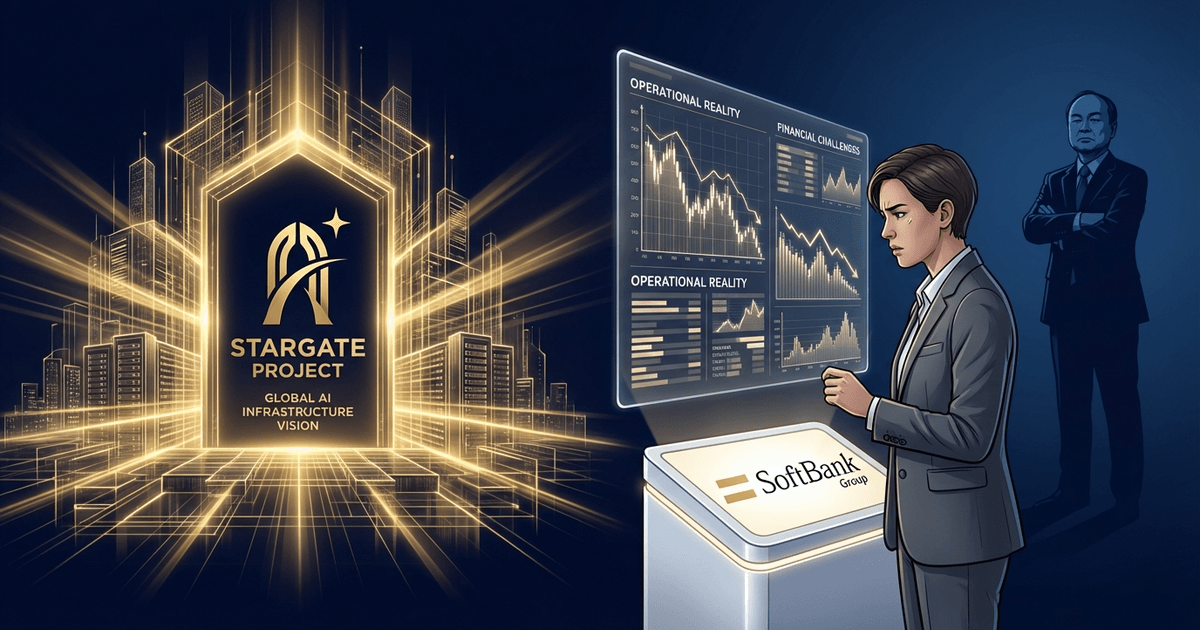
That theme is this: Stargate, the grand AI infrastructure vision, is finally shifting from “announcement narrative” to “operational and financial reality.”
Let me state my own view upfront.
Stargate appears to have been a vision where political and capital-market optics carried somewhat more weight than operational substance from the outset — and reality is now catching up. The most important question to watch is not “will AI grow?” but rather “how far will SoftBank go in concentrating its bet on a single company, OpenAI?”
Why does this matter? To understand the background, we need to first clarify what Stargate is and why SoftBank’s role is so significant.
1. What Is Stargate?
Stargate is a massive AI infrastructure initiative involving OpenAI, SoftBank, Oracle, and others. In January 2025, OpenAI announced plans to invest up to $500 billion over four years to build AI infrastructure across the United States. SoftBank was designated to lead on the financial side, OpenAI on operations, with Oracle as a key partner.
Then in September 2025, OpenAI, Oracle, and SoftBank announced five new data center sites in the U.S., including the Abilene facility and CoreWeave-related projects — totaling approximately 7GW and over $400 billion across three years.
In other words, Stargate is not just a data center construction project. It is a nation-scale AI capital expenditure story that intertwines AI model development, cloud computing, GPU supply, power generation, politics, and capital markets.
And the key point now is that this grand narrative is finally confronting the grounded realities of construction, power supply, GPU generational transitions, financing, and profitability.
2. Why SoftBank Matters
SoftBank is especially important in this context because it is not merely a participant — it is one of the parties bearing the greatest financial risk in this initiative.
In April 2025, SoftBank announced an additional OpenAI investment commitment of up to $40 billion.
Then in December 2025, SoftBank announced the completion of a further $22.5 billion investment.
This means that today’s SoftBank is not spreading its bets thinly across the AI market. Instead, it is placing an extraordinarily concentrated wager on a single company: OpenAI.
Moreover, Reuters reports that SoftBank is seeking a bridge loan of up to $40 billion to finance this investment.
This is critically important. The question at stake is not simply “will the AI market grow?” but rather which companies are trying to capture that growth, at what price, and with how much concentration.
3. SoftBank’s Strength Has Always Been “Find It Early, Bet Big”
I believe Masayoshi Son’s foresight and instinct for opportunity are exceptional — a unique fusion of analysis and intuition refined to an extraordinary degree. SoftBank’s history makes this fairly clear.
SoftBank’s 2025 Annual Report positions the launch of Yahoo! BB in 2001, which brought broadband into Japanese households, as a pivotal moment in the company’s history.
The same report describes how Son, recognizing the dawn of the internet era, invested in Yahoo!, launched Yahoo! JAPAN, and then drove broadband adoption across Japan through Yahoo! BB — a narrative thread woven into SoftBank’s growth story.
The Alibaba investment follows the same pattern. In 2019, Reuters reported that SoftBank’s Alibaba investment — a $20 million bet in 2000 — eventually grew to exceed SoftBank’s own market capitalization in value.
Reuters also reported in 2022 that SoftBank expected to book a gain of $34.1 billion from reducing its Alibaba stake.
Looking at this track record, SoftBank’s winning formula is quite clear:
-
Identify the turning point of an era early
-
Present that shift as a grand narrative to the market
-
Commit at a scale that most executives would hesitate to match
Yahoo! BB and Alibaba are the success stories of this approach. When it works, the first mover takes the lion’s share of the gains. This has been SoftBank’s playbook.
4. But That Strength Is Also a Vulnerability
The problem is that the same approach does not always succeed.
A leader who can paint a grand vision of the future tends to go all-in once convinced. The strategy of leading with a bold narrative is powerful when things go right, but when underlying assumptions begin to shift, the story can look larger than reality warrants.
The textbook example was WeWork.
According to SoftBank’s 2025 Annual Report, after WeWork went through Chapter 11 restructuring, $6.71 billion in previously recorded unrealized losses were reclassified as realized losses.
The same report shows that the SoftBank Vision Funds’ fiscal 2024 realized loss on investments exceeded ¥1.3665 trillion, with WeWork’s restructuring cited as a major contributing factor.
Separate sections of the report also reference financial support provided to WeWork, indicating that the loss was not a one-time event but involved extended aftermath.
The lesson from WeWork is straightforward. When the grand narrative and business reality diverge, SoftBank’s losses tend to run deep.
5. So What Makes the OpenAI Bet Different?
This OpenAI investment is not simply another large bet. To me, it looks like SoftBank and OpenAI are becoming deeply intertwined — their fates closely tied together.
If it works, the upside is enormous. If OpenAI wins across models, products, APIs, and enterprise adoption, this bet may one day be remembered as an Alibaba-level success.
But the downside is not negligible either.
The Information reports that investors are cautious about OpenAI’s IPO for several reasons:
-
The expected valuation is extremely high
-
The path to profitability is long
-
Additional capital raises may be needed in the future
The point here is not to question OpenAI’s technology or competitiveness. Rather, it is that being a strong company and the price at which you bet on it are two separate issues.
What if profitability takes longer than expected? What if the IPO does not command the valuation hoped for? What if massive infrastructure like Stargate does not turn into the high-margin business that was anticipated? Or what if the business itself grows, but the investment price was simply too high?
In that case, this concentrated investment could leave behind a very heavy cleanup — not in the same form as WeWork, but potentially just as burdensome.
6. My Assessment
This brings us back to where we started.
The Abilene expansion pullback. SoftBank’s massive bridge loan report. Investor caution around the OpenAI IPO.
Looking at these together, here is how I see it.
Stargate is not so simple as to say it was pure fiction from the start. Demand for AI infrastructure is real, and the U.S. government’s intent to drive large-scale capital investment appears genuine.
At the same time, Stargate appears to have carried a somewhat outsized share of political and capital-market optics from the beginning. The high-profile White House announcement, the enormous investment figures, the symbolism of AI supremacy and job creation — all of this is evident in OpenAI’s official announcement.
And now, operational reality is catching up to that narrative. Construction takes time. Power is finite. GPU generations advance quickly. Interest rates and capital market conditions change. And AI infrastructure is not as lightweight as software.
That is why I view Stargate not as “a plan that was dishonest from the start,” but as “a vision where the narrative grew large first, and operational reality is now catching up.”
7. Conclusion
Let me restate my conclusion clearly.
Stargate appears to have been a vision where political and capital-market optics carried somewhat more weight than operational substance from the outset — and reality is now catching up. The most important question to watch is not “will AI grow?” but rather “how far will SoftBank go in concentrating its bet on a single company, OpenAI?”
I fundamentally hold Son in high regard. Neither Yahoo! BB nor Alibaba would have happened at that scale under an ordinary executive. His ability to identify opportunities early and rally markets around a grand vision is genuinely exceptional.
But that strength can cut both ways. When the narrative runs ahead and business reality fails to keep pace — as with WeWork — SoftBank’s losses tend to run deep.
So while I am not pessimistic about Stargate, I do believe we have entered a phase that warrants considerably more caution than before.
I am not questioning the future of AI. On the contrary, I believe AI will continue to grow.
How far SoftBank will go in concentrating its bet on OpenAI — that, I believe, is the key factor that will determine the fate of the Stargate project.
Join the conversation on LinkedIn — share your thoughts and comments.
Discuss on LinkedInRelated Posts
From Cluster Strategy to Vertical Integration — SoftBank's Push to Build a Chip-Power-DC Unified AI Empire

SpaceX IPO and the Question of Valuation: How to Price Starlink's Communications Infrastructure and SpaceXAI