Tencent's WeChat AI Agent — Why China Has a Structural Edge in Practical AI
Where OpenAI struggles: China is ahead in making AI agents useful
Another important move in the AI agent race.
According to The Information, Tencent is secretly building a new AI agent for WeChat that can do tasks on behalf of users.
This agent would connect to WeChat’s mini-programs and handle things like ride-hailing, grocery orders, and reservations — all from a chat interface. Testing is expected around mid-year, with wider rollout in Q3.
The key point is that Tencent is not just making another AI chatbot. They are putting AI inside WeChat — an app that already controls how people pay, shop, and get around in China. According to Tencent’s official report, Weixin/WeChat has over 1.4 billion monthly active users, Weixin Pay processes over 1 billion commercial transactions per day, and mini-program GMV reached 8 trillion RMB in 2024.
So Tencent is not chasing “AI chat engagement time.” They want to automate the mini-apps, payments, ride-hailing, and shopping that already exist inside WeChat.
1. What is happening
In short: Tencent is placing an AI agent on top of WeChat, which is already a daily-life platform for over a billion people.
The agent would appear as a conversation in WeChat’s chat list. Users type what they need in natural language, and the agent calls mini-programs behind the scenes — booking rides, ordering food, making reservations. Tencent is treating this as a top-priority, classified project.
Tencent hired Yao Shunyu, a researcher from OpenAI, in September 2024 to strengthen their Hunyuan foundation model. But for the WeChat agent, they are reportedly testing models from Alibaba, Zhipu, and DeepSeek too — not just Hunyuan.
It seems like Tencent cares more about which model works best in practice than about building everything in-house.
2. Tencent’s real strength is not AI itself — it’s payments, logistics, and commerce
Looking at Tencent’s report, WeChat/Weixin is far more than a messaging app:
- Over 1.4 billion monthly active users
- Over 1 billion commercial payment transactions per day via Weixin Pay
- 8 trillion RMB in mini-program GMV in 2024
- Mini Shops that let merchants run stores using Weixin’s social, content, and payment features
A smart AI alone cannot complete real-world tasks. At the end, someone has to:
- Find the product
- Process the payment
- Handle delivery
- Deal with refunds and customer support
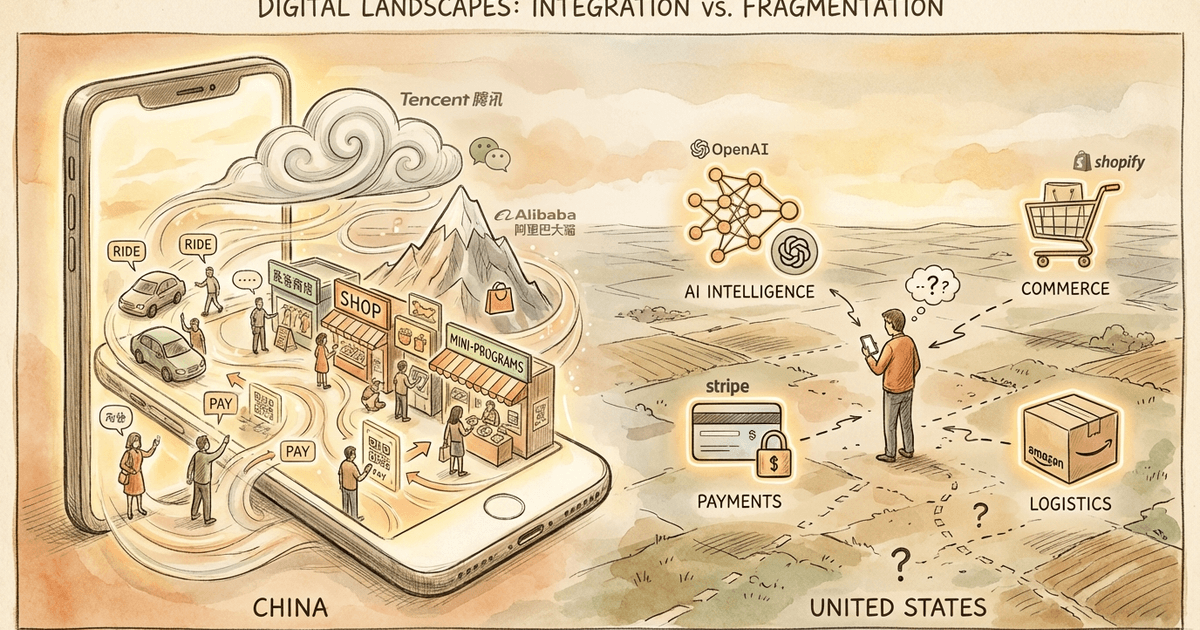
Chinese platforms have kept all of these steps inside one app for years. Alibaba has e-commerce, payments, maps, and travel. Tencent has WeChat, mini-programs, Weixin Pay, and Mini Shops. This vertical integration makes it much easier to turn AI agents into tools that actually finish tasks, not just recommend things.
Tencent’s own materials emphasize that Weixin connects people, content, and services in one place.
3. Why OpenAI is having a hard time with this
This connects to my previous post about OpenAI’s shopping and ads pivot.
The Information reported that OpenAI scaled back its plan for direct checkout inside ChatGPT. They are now pushing shopping toward ChatGPT apps and external sites instead.
According to the report, Shopify decided not to build a ChatGPT app, and traffic from ChatGPT was low. The buy-button click rate was under 1%.
In a separate report, Shopify’s CFO said that real agentic commerce is still “very, very early,” and actual transactions through AI shopping tools remain small.
This is not because OpenAI’s models are weak. The problem is more basic than that.
The US internet grew through horizontal specialization:
- AI chat → OpenAI
- Payments → Stripe, PayPal
- E-commerce → Shopify, Amazon
- Delivery → separate logistics companies
- Maps, rides, bookings → separate apps
This structure is good for deep expertise in each area. But for AI agents, it creates friction at the last step. The AI can recommend a product, but “buy it, pay for it, deliver it, handle returns” requires too many handoffs between different companies.
As a result, OpenAI seems to be struggling not with AI intelligence, but with the operational side — payments, merchant onboarding, and responsibility between platforms.
4. My view: China has a structural advantage in practical AI
This is my personal opinion.
I think cutting-edge foundation models will probably keep coming from the US for a while. OpenAI, Anthropic, Google, and Meta still have strong research teams.
But building the best model and making AI work in daily commerce and life are two different things.
On the practical side, I think Chinese companies have a structural advantage.
Chinese platforms already own the key pieces that AI agents need — payments, e-commerce, logistics, and customer support. They have:
- Chat as a user interface
- Mini-apps as a service layer
- Built-in payments
- Merchant infrastructure
- Transaction data
- Established user habits
This means they can add AI as a new front door and automate their existing commerce network.
US AI companies cannot easily copy this. Even if OpenAI partners with Shopify, Stripe, and various retailers, it will not become the kind of single-app vertical integration that WeChat has.
The fact that even Shopify is not fully committing to OpenAI suggests this friction is significant.
5. Three things that stand out about Tencent’s move
5-1. Embedding AI into WeChat matters more than building a standalone AI app
In China, WeChat is already the entry point for daily life. Growing a new AI app from zero is much harder than putting AI inside an existing super-app. Tencent’s standalone AI chatbot Yuanbao has not grown as fast, so they are now focusing on integrating AI directly into WeChat. This makes sense.
5-2. Tencent is not obsessed with owning the best model
Reports say the WeChat team is testing models from Alibaba and DeepSeek, not just their own Hunyuan. This flexibility is one of China’s strengths. You do not need to own the most advanced research if you can quickly adopt useful technology and apply it to real services.
5-3. In the agent era, model quality is not the only thing that matters
If I step back and look at the bigger picture, the competition is shifting from “which model is smartest” to “who owns the environment where everything can be completed in one step.”
Tencent and Alibaba are well-positioned here. They control the infrastructure around AI — payments, transactions, delivery, support, and user flow.
Even a powerful AI ends up being just a recommendation engine if there is no execution layer behind it. But if you own the execution layer, AI directly increases your transaction volume.
Summary
I do not think the Tencent/WeChat story is just about “AI agents are getting popular in China too.”
The facts are:
- Tencent is preparing an AI agent inside WeChat that can execute real tasks
- WeChat already has over 1.4 billion MAU, over 1 billion daily payment transactions, and 8 trillion RMB in mini-program GMV
- OpenAI is struggling with the execution side of shopping, and Shopify’s CFO says agentic commerce is still “very, very early”
My view is this:
The US will probably keep producing the most advanced AI models for now. But China is stronger at taking those technologies — including external ones — and turning them into real products that handle payments, shopping, logistics, and daily life.
The AI agent competition is not just about models. The winners will not only have smart AI — they will have a world where that AI can directly buy, book, and pay for things.
Join the conversation on LinkedIn — share your thoughts and comments.
Discuss on LinkedInRelated Posts
China's AI Now: OpenClaw Fever and How Alibaba, Tencent, and ByteDance Are Racing to Monetize AI
The New World Driven by Multi-AI Agents — When AIs Review, Complement, and Negotiate with Each Other