OpenAI Steps Back from Shopping, Leans Into Ads — Amazon's Dual Strategy and Alibaba's Vertical Integration
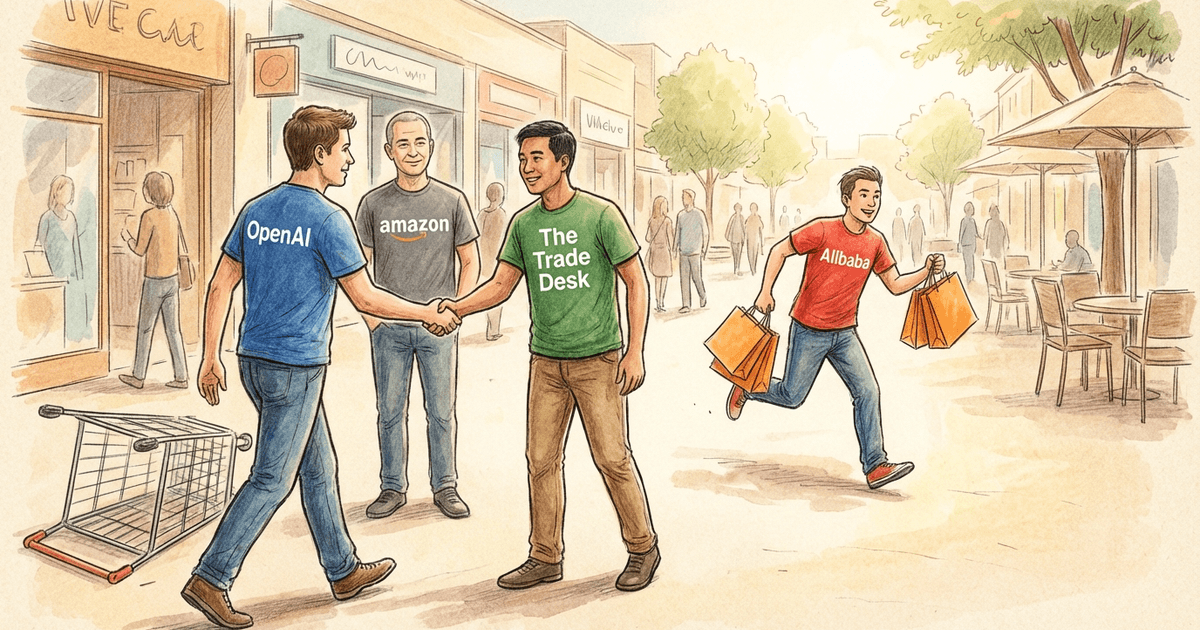
As AI chat becomes a primary entry point for search and purchasing behavior, the strategic directions of major players are diverging rapidly.
OpenAI officially announced that it will test ads in ChatGPT for Free and Go tier users in the US, stating that ads will not influence responses and conversations will not be shared with advertisers. Meanwhile, the company has reportedly scaled back its vision for direct checkout within ChatGPT, shifting toward checkout through connected external apps.
Additionally, OpenAI is reportedly in early discussions with The Trade Desk (TTD) about launching ad sales. Layered on top of this are Amazon’s massive investment in OpenAI and Alibaba’s move to push ahead of US players with transaction-capable AI agents.
This article first lays out the facts, then offers my perspective on why these developments form a coherent picture.
The News
1. OpenAI Scales Back Direct Checkout in ChatGPT
According to The Information, OpenAI has scaled back its plans to let users purchase directly from ChatGPT search results, instead shifting checkout to specific apps connected to ChatGPT (Instacart, Target, Expedia, etc.).
Of Shopify’s millions of merchants, only about a dozen had actually gone live on the platform, the report noted.
2. The Instant Checkout / Agentic Commerce Protocol Remains
OpenAI announced “Buy it in ChatGPT” (Instant Checkout) in 2025 and had been developing the Agentic Commerce Protocol with Stripe. Even after this strategic shift, protocol development is reportedly continuing — meaning OpenAI has not abandoned commerce standardization entirely.
3. OpenAI Launches Ad Testing and Explores Partnership with The Trade Desk
While launching ad tests, OpenAI is reportedly in early discussions with The Trade Desk (TTD) about building out its ad sales operation.
4. Amazon Invests Heavily in OpenAI While Exploring Chatbot Ad Tech for External Sales
Amazon officially announced an investment of up to 50 billion dollars in OpenAI (15 billion dollars initially, plus up to 35 billion dollars conditionally).
At the same time, The Information reported that Amazon is exploring technology to help other apps and sites sell chatbot ads.
5. Alibaba Shows Implementation Speed with Vertical Integration Across Qwen, Payments, E-Commerce, and Travel
The Information reported that Alibaba’s Qwen in-app agents can execute transactions such as ticket bookings, processing approximately 200 million orders during the Lunar New Year campaign period.
The article also referenced Morgan Stanley analysis showing a surge in Qwen’s DAU, though it should be noted that these figures cannot be fully verified externally.
My Perspective
1. OpenAI Is Avoiding the Operational Burden of Commerce in Favor of Ads Ahead of Its IPO
Direct checkout within ChatGPT is an ambitious vision, but the operational reality is heavy:
- Real-time inventory and pricing synchronization
- Fraud prevention and order error handling
- Tax calculation (state taxes, etc.) and settlement
- Merchant onboarding overhead
Advertising, while far from simple, has a more scalable structure than transaction operations. The fact that OpenAI is launching ad tests and moving quickly with external ad tech partners reflects this reality, in my view.
My assessment is that advertising aligns better than payments with short-term monetization and the profitability narrative that investors expect.
2. Amazon Is Both Patron and Competitor — Why OpenAI Needs Neutrality in Ads
Amazon has invested heavily in OpenAI and deepened ties through cloud and chip partnerships. Yet Amazon is also the strongest competitor in both advertising and commerce. On top of that, Amazon is exploring the external sale of chatbot ad technology.
If OpenAI leaned too heavily on Amazon for its ad infrastructure, two concerns would emerge:
- Retail and e-commerce partners and advertisers would worry about data flowing to Amazon
- OpenAI’s own room to build an independent ad business would shrink
This is why using a more neutral-appearing external ad tech partner like TTD during the launch phase makes strategic sense, in my view.
3. Why TTD — Preserving Data Sovereignty with UID2, Avoiding Model Competition
Beyond neutrality, I believe OpenAI’s consideration of TTD makes sense from a data sovereignty perspective — specifically, the ability to avoid sharing raw data.
TTD is an ad exchange infrastructure (DSP), not an AI model company that trains and serves LLMs, which reduces the risk of model competition. Additionally, the advertising industry has mechanisms like UID2 (encrypted IDs), promoted by TTD, that allow working with identifiers in encrypted form.
By leveraging such frameworks, OpenAI could launch its ad business without sharing raw conversation data while retaining leverage for eventual in-house development. That is my reading of the situation.
4. Alibaba’s Vertical Integration Tackles the “Last Mile of Execution” That US Players Struggle With
What OpenAI is struggling with is not AI capability per se, but the surrounding systems needed to execute commercial transactions.
Alibaba holds its own AI (Qwen), payment infrastructure (Ant/Alipay), e-commerce platforms (Taobao, etc.), maps and local services (Amap), and travel/ticketing (Fliggy/Damai) within its group. When cross-platform integration advances, the distance to execution shortens significantly. The reporting highlights this advantage.
That said, it is far from perfect. The article also describes cases where the agent claimed a reservation was made when it actually was not (The Information).
My view is that in a world where AI completes the purchase, the eventual winner will be less about model performance alone and more about which player can unify payments, inventory, and logistics — and Alibaba appears to be in the shortest path to that position.
A Deeper Layer: This Is About Control
Abstracting my analysis one level further, I see this as fundamentally a question of control rather than technology.
For OpenAI, Amazon is simultaneously its greatest ally and its most formidable competitor. This is precisely why OpenAI needs to deliberately preserve neutrality at the core of its monetization — both in advertising and commerce.
In advertising specifically, if OpenAI were to rely heavily on Amazon’s ad infrastructure from the start, concerns would inevitably arise: “Is data flowing to Amazon?” “Are Amazon products being favored?” These are sensitive issues for retail partners and advertisers alike. It would not be surprising if OpenAI is taking a two-phase approach: using neutral-appearing external players like TTD initially while keeping in-house development as an eventual option.
Amazon, for its part, maintains the face of a supportive investor while simultaneously positioning itself to collect tolls from chatbots beyond ChatGPT through its external ad tech offering.
Counterarguments: Alternative Readings
1. The Shopping Pullback May Simply Reflect Lack of Product-Market Fit
If users primarily “research but don’t buy” in ChatGPT, the pivot could be a product-driven necessity rather than any strategic consideration involving Amazon.
2. The TTD Talks May Be About Speed, Not Neutrality
In the early stages of an ad business, measurement, delivery, and brand sales operations are resource-intensive. Partnering with established ad tech like TTD could be a pragmatic decision to monetize as quickly as possible, not a deliberate move to distance from Amazon.
3. Amazon’s External Ad Tech May Target a Different Market Entirely
Amazon’s chatbot ad technology offering may aim first at mid-tier and peripheral players rather than major platforms like ChatGPT. In that case, OpenAI’s TTD partnership and Amazon’s external push are not competing but rather addressing different market segments.
4. Alibaba Is Fast but Rough — and Roughness Can Be Fatal
A common pattern among Chinese tech companies is shipping early and iterating in production, prioritizing speed and traction. If quality issues become visible, there is a risk that US players could overtake them over time through reliability and trust-building.
The article itself describes failures such as claiming a reservation was made when it was not — a potentially fatal issue for transaction-executing agents. Such agents are particularly sensitive to failure, as a single error can destroy the user experience. The disadvantage of moving too fast may become more pronounced over time.
5. “Buying Through Chat” May Never Become Mainstream
At the most fundamental level, if users continue using chat for research and comparison but prefer conventional e-commerce apps for checkout, the entire premise of “AI swallowing commerce” may unfold more gradually than expected.
Summary
The verifiable facts are as follows:
- OpenAI is scaling back direct checkout within ChatGPT in favor of app-based checkout integration
- Simultaneously, it is pivoting to advertising and moving quickly with external ad tech (TTD) partnerships
- Amazon is a major OpenAI investor while also exploring external sales of chatbot ad technology
- Alibaba is leveraging vertical integration to push into transaction execution ahead of US players
My view is that:
OpenAI is shifting from operationally heavy commerce toward more scalable advertising ahead of its IPO. Amazon is positioning to control both advertising and infrastructure. Alibaba is using vertical integration to capture execution first.
AI-powered chat advertising and shopping are still in their early stages. The direction will likely be determined by who secures control and who builds enough trust to earn it.
Join the conversation on LinkedIn — share your thoughts and comments.
Discuss on LinkedInRelated Posts

Three Players, Three Prizes — How Amazon, Pinterest, and Elliott Converge on Chatbot Advertising
Amazon and Microsoft's Strategic Rivalry Over OpenAI — The Stateful vs Stateless Design Battle