Three Players, Three Prizes — How Amazon, Pinterest, and Elliott Converge on Chatbot Advertising
As AI chat becomes a primary entry point for search and purchasing behavior, the question of how to place ads within chat is emerging as the next advertising battleground. OpenAI has officially announced that it will test ads in ChatGPT for Free and Go tier users in the United States.
Two recent developments caught my attention. First, The Information reported that Amazon is exploring technology to help external apps and sites sell chatbot ads. Second, activist investor Elliott Management made a $1 billion investment in Pinterest.
These two stories appear unrelated at first glance, but I believe they connect along a single axis — AI-powered ad optimization — and can be understood through the lens of which player stands to gain what.
The News
Amazon Exploring Chatbot Ad Technology for External Partners
According to The Information, Amazon is considering using Amazon Publisher Services (APS) to provide technology that enables external apps and sites to sell ads within AI chat interfaces. The reported motivation: as users increasingly turn to AI chat for search and information gathering, Amazon seeks to strengthen the foundation of its advertising business — already a major revenue driver.
Amazon commented that there are “no specifics to share at this time,” suggesting the initiative remains in early stages.
Pinterest Named as a Potential User
In the same article, Amazon reportedly cited Pinterest as a potential partner when explaining this concept. Pinterest has launched an AI-powered shopping recommendation assistant and has begun testing ads within it.
The fact that Amazon specifically named Pinterest in the context of external chatbot ad distribution is worth noting.
Pinterest Receives $1 Billion Elliott Investment and Announces Major Buyback
In a separate report, Pinterest received a 3.5 billion share buyback program. The backdrop includes recent growth deceleration, cost reductions through workforce cuts, and a strategic shift toward AI.
The Current State of Chatbot Advertising
Chatbot advertising is still in its early stages. Both advertisers and publishers face unresolved questions:
- What ad formats can work without degrading user experience?
- How should measurement and tracking be designed?
- How do you connect LLMs with existing ad tech infrastructure?
The flip side of this ambiguity is that the window for establishing standards — and infrastructure dominance — remains wide open. Amazon appears to be pursuing not just ads within its own e-commerce ecosystem, but a “toll booth” position on chat as a new advertising surface.
My Analysis: Three Players, Three Prizes
What follows is my interpretation. These are hypotheses, not certainties, but connecting the dots from public reporting yields a coherent picture.
Mid-Tier Platforms Are Struggling with In-House Ad AI
Ad optimization at the Meta or Google level requires massive data, compute, and talent. For mid-tier platforms, keeping pace in-house is becoming increasingly difficult.
Meta, for example, leverages advanced AI models to optimize ads and raise profit margins, while platforms like Pinterest fall behind in ad precision due to AI model performance gaps. Pinterest has reportedly declared internal “Code Reds” to address growth challenges.
In this context, if Amazon offers chatbot ad sales technology to external partners, the “buy or partner” option becomes increasingly realistic for companies like Pinterest.
Pinterest’s Ad Inventory Could Be Attractive to Amazon
Pinterest is a platform where purchase intent surfaces naturally — users actively search for things they want to buy or try. If AI chat can draw out that intent, the advertising optimization potential is significant.
Should Amazon become the infrastructure provider for external chatbot ads, Pinterest could serve as an ideal showcase partner.
Elliott’s Investment Creates Pressure for Faster Revenue Improvement
Activist investors typically focus on profitability and capital efficiency. If Pinterest cuts headcount, shifts resources toward AI, and outsources ad technology rather than building it in-house, the company becomes leaner and more profitable — even if outsourcing means paying fees to a partner like Amazon.
In this light, the sequence of Elliott’s investment, share buybacks, workforce reductions, and AI focus forms a coherent narrative: slimming down operations to improve overall profitability.
Counterarguments
For a balanced perspective, here are the scenarios that could undermine this thesis:
-
User backlash kills chatbot ads altogether — Chat serves as a space for consultation, search, and comparison. Intrusive ads could trigger strong resistance, limiting ad placement to a fraction of what’s commercially viable.
-
Measurement gaps prevent advertiser adoption — Without clear attribution and tracking, advertisers may hesitate to shift significant budgets, leaving chatbot ads as a hype-driven experiment.
-
Pinterest prioritizes in-house AI over external dependency — Relying on external infrastructure could erode margins and data control, leading Pinterest to bet on internal capabilities instead.
-
Amazon-centric bias undermines platform neutrality — If ads appear too heavily skewed toward Amazon’s e-commerce ecosystem, user and merchant backlash could damage Pinterest’s platform value.
Conclusion: Amazon Gets the “Toll,” Pinterest Gets Revenue Growth, Elliott Gets Capital Gains
My summary of the strategic picture:
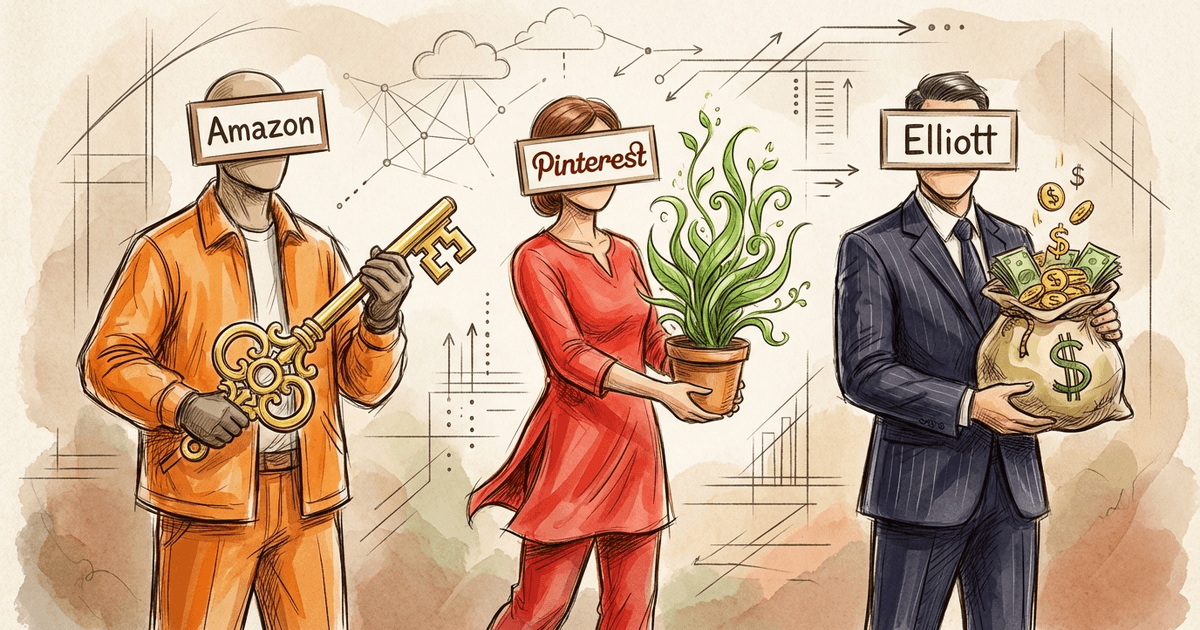
- Amazon — Seeks to distribute chatbot ad sales infrastructure externally, expanding its reach into fees, data, and advertiser relationships beyond its own ecosystem
- Pinterest — By cutting headcount, shifting to AI, and outsourcing ad tech, it can slim down and improve profitability without building everything in-house
- Elliott — Pushing for leaner operations and shareholder returns, with a rational interest in accelerating the outsourcing strategy
This is, of course, speculative. There is no confirmed deal between Amazon and Pinterest, and the specifics of any ad arrangement — revenue sharing, data handling, technical integration — remain invisible from the outside.
However, as chatbot advertising grows into a new market, the infrastructure provider side naturally gains leverage. This aligns with the needs of companies like Pinterest and Snap, which are struggling to close the AI model performance gap with big tech in ad optimization. Amazon is well-positioned to fill that role.
If this scenario unfolds, Pinterest could be redefined — not as a social media platform, but as an “AI chat UI that surfaces purchase intent.” And Amazon, by controlling the ad engine running on top of it, could extend its advertising business far beyond its own site.
This is still early-stage, but as AI chat becomes a search alternative, the advertising battleground will shift accordingly. This is a theme worth following closely.
Join the conversation on LinkedIn — share your thoughts and comments.
Discuss on LinkedInRelated Posts
OpenAI Steps Back from Shopping, Leans Into Ads — Amazon's Dual Strategy and Alibaba's Vertical Integration
Amazon and Microsoft's Strategic Rivalry Over OpenAI — The Stateful vs Stateless Design Battle