Toward Robots That Move with Only Words and Videos: What Is the "ChatGPT Moment for Robotics," and How Will It Happen?
Introduction: Toward an Era of Robots That Move Just by Being Shown Words or Videos
In September 2026, OpenAI announced “GPT-6 Astra,” a model that understands spatial and temporal relationships in the physical world. After that, OpenAI also published use cases for engineering and simulation acceleration in the physical world. In response, Deepu Talla, Vice President of Robotics and Edge AI at NVIDIA, spoke in an interview with the US media outlet The Information. He praised Astra for making the building of 3D simulation environments, which used to take several months, 100 times faster.
In this interview, Talla predicted that a “ChatGPT moment for robotics” will come within the next one to three years.
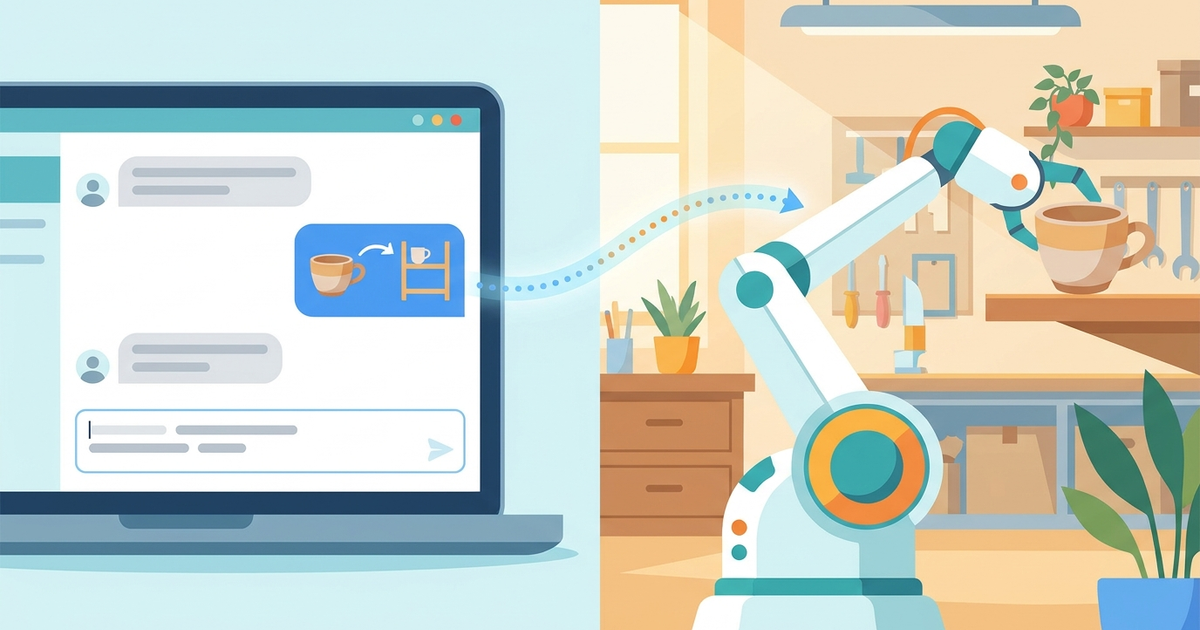
When ChatGPT appeared, we could get an answer right away just by asking in a chat. The “ChatGPT moment for robotics” means the same thing happening for robots: just by giving them instructions in words or showing them one example video, robots will move as we ask. Talla himself defines the ChatGPT moment as “hundreds or thousands of use cases passing the ‘10-second wall’ (explained below) without being trained on each one.” This compares to how AI before ChatGPT was a specialist that could solve only one or two problems.
flowchart LR
    subgraph C["ChatGPT (today)"]
        C1["Ask in a chat"] --> C2["It handles<br/>individual tasks"]
    end
    subgraph R["Robots (coming)"]
        R1["Give instructions in words /<br/>show one example video"] --> R2["It moves<br/>as asked"]
    end
    C -. same experience .-> R

    classDef chat fill:#eff6ff,stroke:#2563eb,stroke-width:2px;
    classDef robot fill:#ecfdf5,stroke:#059669,stroke-width:2px;
    class C1,C2 chat;
    class R1,R2 robot;
Until now, most robots have been “single-purpose machines,” such as picking up the same part at a fixed spot in a factory. From now on, robots will be able to look at the situation in front of them, think for themselves, and handle hundreds or thousands of different tasks, without expert engineers rewriting programs for each site.
| Robots until now | Robots from now on | |
|---|---|---|
| Role | Single-purpose machine | General-purpose partner |
| Tasks | Pick up the same part at a fixed spot | Hundreds or thousands of different tasks |
| Adapting to a site | Expert engineers rewrite programs for each site | Look at the situation and think for themselves |
Why will this change happen? In this post, I will organize the walls that traditional robot development faced, the latest technologies such as Astra, and a practical approach for using them on real sites.
1. Why Did Robots Need to Be Custom-Built for Each Site?
Until now, industrial robots could only do a single task, such as “pick up this box, at this position, in this factory, and put it next to it.” If the shape or position of the object changed even a little, the robot would stop.
Behind this, there were three major walls.
flowchart TD
    W1["(1) The 10-second wall<br/>(minimum line for real use)"] --> X["Custom work needed for each site<br/>= higher deployment cost"]
    W2["(2) Cost of building virtual<br/>environments (simulators)"] --> X
    W3["(3) The glue code wall<br/>for connecting site equipment"] --> X
    X --> Y["Robots stayed<br/>single-task machines"]

    classDef wall fill:#fef2f2,stroke:#dc2626,stroke-width:2px;
    classDef result fill:#f8fafc,stroke:#64748b,stroke-width:2px;
    class W1,W2,W3 wall;
    class X,Y result;
The “10-Second Wall”: The Minimum Line to Be in the Game
Talla compares the path to practical robots with the 100-meter sprint. To win an Olympic gold medal, you need about 9.6 to 9.7 seconds. But before that, you have to run under 10 seconds just to qualify for the Olympics. This “10 seconds” is the “10-second wall” in the sense of the minimum line for being in the game.
Talla says autonomous driving finally got past this wall, thanks to end-to-end models with reasoning and simulation technology that can generate edge cases that are very hard to meet in the real world. Robots, on the other hand, have hundreds or thousands of use cases, and only some of them, such as moving things around and picking and placing rigid objects, have passed the wall.
flowchart LR
    Q["Under 10 seconds<br/>= qualifying<br/>(in the game)"] --> G["9.6-9.7 seconds<br/>= gold medal<br/>(deployment at scale)"]
    AD["Autonomous driving"] -. reached .-> Q
    RB1["Moving things<br/>Pick and place of rigid objects"] -. reaching .-> Q
    RB2["Hundreds or thousands<br/>of other use cases"] -. not yet .-> Q

    classDef goal fill:#eff6ff,stroke:#2563eb,stroke-width:2px;
    classDef done fill:#ecfdf5,stroke:#059669,stroke-width:2px;
    classDef todo fill:#fef2f2,stroke:#dc2626,stroke-width:2px;
    class Q,G goal;
    class AD,RB1 done;
    class RB2 todo;
The Cost of Building Virtual Environments (Simulators)
If a real robot practices by failing tens of thousands of times, the machine will break. That is why training in a virtual space on a computer (a simulator) is the standard approach. Until now, however, engineers did the work by hand: turning the factory and the target objects into 3D data, and setting physical properties such as weight and friction. Building just one environment took several months.
The “Glue Code” Wall for Connecting Site Equipment
To run a robot on a real site, you need to connect not only the robot itself but also cameras, conveyor belts, control panels (PLCs), and existing management software. System integrators wrote the programs that connect these (glue code) by hand for each site. This pushed up deployment costs, and it made adoption difficult for small and medium-sized companies doing high-mix, low-volume production (such as the Mittelstand in Europe).
flowchart LR
    CAM["Cameras"] --- G
    CNV["Conveyor belts"] --- G
    PLC["Control panels (PLC)"] --- G
    SW["Existing management software"] --- G
    G["Glue code<br/>(handwritten for each site)"] --- RB["Robot"]

    classDef glue fill:#fff7ed,stroke:#ea580c,stroke-width:2px;
    class G glue;
2. Why Can Robots Move with Only “Instructions or Videos,” Like ChatGPT?
We can use ChatGPT as an “AI that can do anything” without thinking about it because “pre-training” and “post-training” work together as one set behind the scenes. In fact, the same structure is starting to come together in robotics.
| Stage | The world of ChatGPT (LLM) | The world of robotics (what’s coming) |
|---|---|---|
| Pre-training | Learns “language and common sense about the world” from huge amounts of text on the internet | Learns “space, physical laws, and basic motions” from huge amounts of physical data and video (foundation models) |
| Post-training | Gains “the ability to follow each user’s specific request right away” through instruction tuning and similar methods | Adapts on its own to “the tasks specific to each site” through automatic environment building with Astra and similar tools + fast RL/IL in virtual space |
| Experience on site | Users can get individual work done just by giving instructions in a chat, without thinking about it | Without expert engineers, robots can do individual tasks just by being given videos or words on site |
Research on “pre-training (foundation models with physical common sense)” had already been moving forward in robot development. However, the biggest bottleneck was “post-training to fit each factory’s or site’s special environment and tasks,” which took months and a great deal of human effort.
flowchart LR
    P["Pre-training<br/>(foundation models with physical common sense)<br/>research was progressing"] --> Q["Post-training<br/>(adapting to each site's environment and tasks)<br/>months and a lot of human effort"]
    Q --> U["Robots that work<br/>on real sites"]

    classDef done fill:#ecfdf5,stroke:#059669,stroke-width:2px;
    classDef neck fill:#fef2f2,stroke:#dc2626,stroke-width:2px;
    class P done;
    class Q neck;
What OpenAI’s Astra and NVIDIA’s simulation platforms (Isaac Sim, Cosmos, and others) changed is exactly this second half of the process.
flowchart LR
    V["Site footage and videos"] --> A["Automatic generation of<br/>3D space and physical environments<br/>with Astra and similar tools"]
    A --> S["Large-scale trials in virtual space<br/>(imitation learning IL / reinforcement learning RL)"]
    S --> R["Deploy to real robots<br/>(break the 10-second wall)"]
    M["Site equipment manuals"] --> AG["Automatic integration code<br/>generation by AI agents"]
    AG --> R

    classDef ai fill:#eff6ff,stroke:#2563eb,stroke-width:2px;
    classDef sim fill:#ecfdf5,stroke:#059669,stroke-width:2px;
    class A,AG ai;
class S sim;-
Simulation environments 100 times faster (Real-to-Sim): Just by inputting footage or videos shot in the real world, AI understands the spatial structure and the physical properties of objects, and automatically mass-produces 3D simulation environments with many variations.
-
Thorough training in virtual space (IL / RL): Inside countless automatically generated virtual environments, the robot repeats trial and error (such as reinforcement learning) tens of thousands of times, while object positions and lighting conditions are changed at random. Through this, it learns even “how to recover when it fails to grab something (recovery motions),” and breaks the “10-second wall” on real machines.
-
Site integration by AI agents: AI agents read the site’s equipment manuals and specifications by themselves, and also automatically generate the code to connect peripheral devices.
| Traditional wall | Until now | From now on |
|---|---|---|
| Cost of building virtual environments | Engineers turned sites into 3D data by hand; months per environment | AI mass-produces them automatically from footage and videos (100 times faster) |
| The 10-second wall | Only some use cases, such as moving things and handling rigid objects, have reached it | Tens of thousands of trials in virtual space teach even recovery motions |
| The glue code wall | System integrators wrote it by hand for each site | AI agents read manuals and specs and generate it automatically |
In this way, when “large pre-trained models” and “fast post-training pipelines that finish automatically behind the scenes” become one, people on site will be able to run robots just by giving instructions in words or videos, without thinking about difficult settings at all.
3. How a “Behavior Script” Approach Complements Astra’s Environment Building
If Astra is “a technology that mass-produces 3D simulation environments (the stage) from video, 100 times faster,” then the next important process is “how to make the robot learn behaviors efficiently inside these many prepared virtual environments (training the actor).”
Today, top labs around the world are also researching methods that “directly infer a robot’s motor control values from videos of human work (End-to-End).” However, methods that learn directly from how a video looks have a weakness: it is hard for them to learn “how to recover when something fails and the object shifts (recovery)” and “delicate force control.”
What I am currently working on is a “staged learning pipeline that starts from AI-generated behavior scripts (Expert Scripts).” It fits very well with environment generation technologies like Astra, and the two complement each other.
flowchart LR
    V["One work video"] --> ES["AI converts it into an Expert Script<br/>(coordinates and conditions as variables)"]
    ES --> IL["Mass-produce hundreds of IL datasets<br/>on many environments made with Astra and similar tools"]
    IL --> DG["Automatic recovery learning<br/>with DAgger from failed trajectories"]
    DG --> RL["Finish the remaining physical edge cases<br/>with reinforcement learning (RL)"]

    classDef script fill:#eff6ff,stroke:#2563eb,stroke-width:2px;
    classDef train fill:#ecfdf5,stroke:#059669,stroke-width:2px;
    class ES script;
    class IL,DG,RL train;
By combining this method, we can make the most of the countless automatically generated simulation environments.
-
Mass-produce structured variations from a single video
By having AI write out the motion in a video as a “control script (code),” the coordinates of objects and the positions of obstacles can be handled as variables. Matching the many 3D environments prepared by Astra and similar tools, hundreds of imitation learning (IL) datasets for different situations can be generated automatically from one video, while keeping the “intent of the work” behind the video. -
Automate recovery learning with DAgger
Normally, “DAgger,” a method that re-teaches the correct recovery action from a state where imitation learning failed, does not scale because a human has to step in by remote control. But if the expert is “a computable script written by AI,” then the moment a trajectory goes off course in the simulator, the recovery trajectory can be calculated automatically and added to the dataset. -
Minimize the exploration cost of reinforcement learning (RL)
Running reinforcement learning from scratch on many environments needs a huge amount of compute time. First, IL and DAgger fix the rough success trajectories and recovery motions. Then only “subtle friction and bending at contact,” which the script’s geometric calculations cannot handle, is left to RL at the end. This achieves both a high success rate and fast learning.
flowchart TD
    subgraph H["DAgger: when a human steps in"]
        H1["Trajectory goes off course"] --> H2["A human teaches the correct<br/>recovery by remote control"] --> H3["Does not scale"]
    end
    subgraph S["DAgger: when the expert is a script"]
        S1["Trajectory goes off course"] --> S2["The script calculates the<br/>recovery trajectory automatically"] --> S3["Added to the dataset<br/>automatically"]
    end

    classDef human fill:#fef2f2,stroke:#dc2626,stroke-width:2px;
    classDef auto fill:#ecfdf5,stroke:#059669,stroke-width:2px;
    class H2,H3 human;
class S2,S3 auto;| Stage | Role | What it covers |
|---|---|---|
| Imitation learning (IL) | Mass-produce hundreds of datasets from one video | Rough success trajectories |
| DAgger | Calculate recovery trajectories from off-course states and add them | Recovery motions |
| Reinforcement learning (RL) | Final finishing | Subtle friction and bending at contact |
In other words, Astra handles “the technology that automatically builds the 3D stage (environment) from video,” and my approach handles “the technology that automatically writes the actor’s script (Expert Script) from video.” When these two fit together, the post-training cycle that produces a real-machine-level control model from one video becomes even more realistic and faster.
flowchart LR
    V["One work video"] --> ST["Astra<br/>builds the stage (3D environment)"]
    V --> SC["Behavior script<br/>writes the actor's script (Expert Script)"]
    ST --> PT["Post-training cycle<br/>(IL, DAgger, RL)"]
    SC --> PT
    PT --> OUT["Real-machine-level<br/>control model"]

    classDef stage fill:#eff6ff,stroke:#2563eb,stroke-width:2px;
    classDef script fill:#fdf4ff,stroke:#a21caf,stroke-width:2px;
    classDef train fill:#ecfdf5,stroke:#059669,stroke-width:2px;
    class ST stage;
    class SC script;
    class PT,OUT train;
Summary
The “ChatGPT moment for robotics” means that, as when ChatGPT appeared, robots will carry out actions on site exactly as we ask, just by our giving instructions in words or showing videos.
As AI takes over the “environment building” and “teaching of motions” that people used to spend months on behind the scenes, I believe robots will change from special equipment for a few large companies into general-purpose partners that are used as a matter of course in small and medium-sized companies and everyday workplaces.
References
- OpenAI: GPT-6 Astra: A new generation of intelligence
- OpenAI: Accelerating engineering for the physical world (using GPT-6 Astra for physical simulation)
- ChainCatcher: NVIDIA Robotics Business Head: OpenAI Astra can accelerate certain robot simulations by 100 times
- NVIDIA: Isaac Sim - Robotics Simulation and Synthetic Data Generation
Join the conversation on LinkedIn — share your thoughts and comments.
Discuss on LinkedInRelated Posts

Part 6. Taking Only the Voice Out of Recordings Made in Noisy Places: Trying NVIDIA's Noise Removal AI "NemotronLabs RE-USE"
Reading Marvell's Acquisition of Lumentum from the Technology Side: Optical Memory Pooling and NVIDIA's Ecosystem Strategy