SpaceX IPO and the Question of Valuation: How to Price Starlink's Communications Infrastructure and SpaceXAI
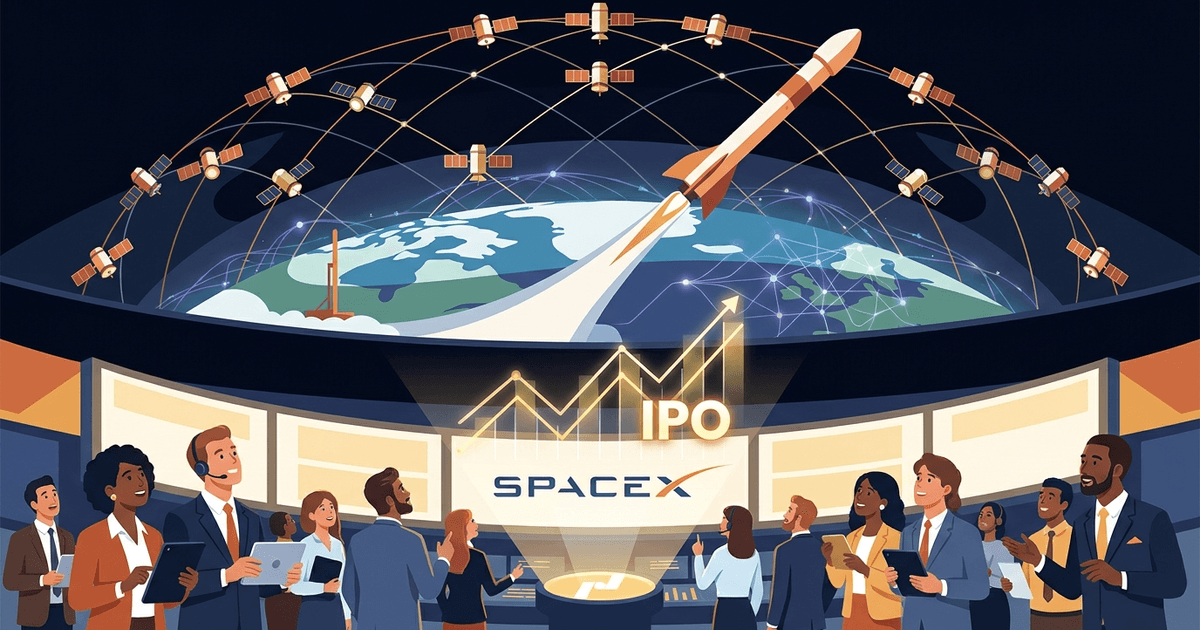
The SpaceX IPO is not simply a space company going public.
The core question is how to value two things on the same balance sheet: Starlink, a cash-generating global communications infrastructure, and SpaceXAI, the AI infrastructure business that absorbed the old xAI.
According to Reuters, SpaceX is on track to list on Nasdaq as early as June 12, 2026, under the ticker SPCX. The prospectus is expected around May 20, the roadshow on June 4, and pricing on June 11. Targeted proceeds are about $75 billion at a valuation of around $1.75 trillion. If it closes, it will be one of the largest IPOs ever.
A 5-for-1 stock split has also been approved just before listing. The fair value per share is adjusted from $526.59 to $105.32 — partly a design choice to make the price look more accessible to retail investors (Reuters).
Investors Are No Longer Buying a “Rocket Company”
What is easy to miss in this IPO is that SpaceX is no longer the same SpaceX.
In February 2026, SpaceX absorbed xAI. The deal valued SpaceX at $1 trillion and xAI at $250 billion, with a combined post-merger valuation of $1.25 trillion. Reuters described the deal as a move to bundle SpaceX’s space business with xAI’s AI business.
So what investors are actually buying in this IPO is not a pure rocket company.
They are buying a bundle of three things:
| Segment | Role | Investor character |
|---|---|---|
| Starlink | Global communications infrastructure | Present value (cash-generating) |
| Rocket business | In-house transport to support Starlink | Cost center and strategic moat |
| SpaceXAI | AI / data center business absorbing xAI | Future value (investment phase) |
Valuation Build-Up (Reported Figures)
Without this structure in mind, the $1.75 trillion number is easy to misread.
1. Starlink Is Not a “Space Dream” — It Is Already Communications Infrastructure
The biggest pillar supporting SpaceX’s valuation is Starlink.
Starlink is no longer just satellite internet. It is becoming a global communications infrastructure that covers areas without terrestrial coverage, aircraft, ships, military and government use, emergency communications, and even direct-to-smartphone connectivity.
The key point is that SpaceX builds its own rockets.
Normally, satellite communications companies depend on outside launch providers every time they put up a satellite. SpaceX, by contrast, uses Falcon 9 and eventually Starship to launch its own Starlink satellites.
So SpaceX’s strength is not in selling rockets. It is in using its in-house rockets to deploy Starlink faster, cheaper, and at greater scale than competitors.
In this sense, the rocket segment is less a product line and more an internal infrastructure cost that supports Starlink.
2. SpaceXAI’s Core Shift Is From Model Development to Data Center Business
The most important part of this IPO is that the old xAI has been absorbed into SpaceX and reorganized as SpaceXAI.
SpaceX has become a company that bundles space, communications, and AI. But from an investor’s perspective, SpaceXAI should not be seen as just an AI model company.
In my view, what is actually happening is a shift from an AI model development company to an AI data center company.
The reasoning is straightforward.
| Strategy | Competitors | Ease of explaining to investors |
|---|---|---|
| AI model development (Grok) | OpenAI / Anthropic / Google / Meta | Winner-takes-most, hard to bet on |
| AI data center (Colossus) | AWS / Azure / CoreWeave | Bets on AI demand itself |
AI model development is high risk. Staying competitive with OpenAI, Anthropic, Google, and Meta requires researchers, data, GPUs, inference cost, and product distribution. Whether Grok can overtake OpenAI or Anthropic head-on is unclear.
An AI data center, on the other hand, is easier to explain to investors.
If you control GPUs, power, cooling, land, and networking, you can rent compute to external AI companies. That is a bet on AI demand itself, not on which model wins.
Colossus Compute: Renting Is Already Happening
SpaceXAI has already signed a contract to provide Colossus 1 compute to Anthropic (xAI).
According to Reuters, Anthropic has contracted for the full compute capacity of SpaceX’s Colossus 1 facility, which holds over 220,000 NVIDIA GPUs. On top of that, 300 megawatts of new capacity will be delivered within a month. Reuters notes that this deal serves as a “marquee customer” for SpaceX to point to as it explains its AI business to investors ahead of the IPO.
In power terms, SpaceXAI’s data center additions are stacking up fast.
This matters.
SpaceXAI does not necessarily need Grok to beat OpenAI or Anthropic. If it rents compute to winning AI companies like Anthropic, it can monetize the infrastructure side of the AI boom.
The investor story for SpaceXAI is shifting to not “beat ChatGPT with Grok,” but “supply the giant data centers AI companies need.”
The second framing has a much clearer ROI.
3. Can Colossus Be Reborn as a Revenue-Generating AI Data Center?
Put plainly, the question is simple. Can Colossus shift from a “compute facility for in-house research” that has been burning cash into an AI data center that generates revenue from external customers?
The Anthropic deal is what makes this shift concrete. Instead of using GPUs only for Grok, SpaceXAI rents them out to external AI companies and turns the data center into a cash-generating asset.
One important caveat: Colossus is not being rented out like a public cloud (AWS, Azure, GCP), which sells API access to many small and mid-sized users. The reported contract gives Anthropic the full capacity of Colossus 1 — a single, large, wholesale-style commitment from one hyperscale AI customer. The business shape is closer to colocation and wholesale data center providers that secure massive power and land for hyperscalers, not a general-purpose cloud platform.
SpaceX also holds the right to acquire Anysphere — the developer of the AI coding tool Cursor — for $60 billion later this year, and can collaborate on a roughly $10 billion deal if it does not exercise that right, according to AP News. Cursor itself has said it will significantly expand its model development using xAI’s Colossus infrastructure.
What this shows is that SpaceXAI’s aim is not a chatbot contest. Through Grok, Cursor, Anthropic, and Claude Code, SpaceXAI is trying to lock down the compute underneath AI applications, rather than betting directly on which application wins.
Viewed as standalone xAI, the business looks like a money-burning AI model company. Viewed as SpaceXAI, it can be re-rated as an infrastructure company that monetizes AI data centers.
xAI Standalone Cost Structure (Reported Estimates)
That said, the cost of pivoting to a data center business is not small. Based on public reporting, xAI’s monthly cash burn is at a meaningful scale on its own.
| Item | Reported scale |
|---|---|
| Monthly cash burn (estimate) | Around $1 billion |
| Annualized | $10–12 billion range |
| Recent funding round | Several billion USD (Series C and later) |
In other words, even after the reorganization into SpaceXAI, the AI data center business may continue to consume Starlink cash until it becomes self-funding. Whether this gets priced in correctly is the hardest part of judging the $1.75 trillion valuation.
4. The Data Center Pivot Carries Its Own Major Risks
The pivot is not a free lunch.
The biggest risk is power and operating efficiency.
An AI data center is not done once you buy the GPUs. It also needs power, cooling, transmission, land, permits, networking, and operating software.
WIRED has reported that xAI added mobile gas turbines for Colossus 2 and is facing local lawsuits over air pollution and permitting. The article says 46 turbines are operating at Colossus 2, and more than 500 megawatts of natural gas turbines have been added since mid-March.
This shows that SpaceXAI is already moving as an AI infrastructure company. It also shows that AI data center business is strongly constrained by physical, on-the-ground factors.
The orbital data center vision is attractive. But today’s AI compute depends on terrestrial power, gas turbines, cooling, local residents, and environmental regulation.
The risk has changed type. It has moved from model development risk to power, data center operations, regulatory, and environmental risk.
5. Nasdaq and S&P Early Inclusion: The IPO Is Designed Around Index Mechanics
Another important point is why SpaceX chose Nasdaq.
Reuters reports that SpaceX chose to list on Nasdaq partly to target early inclusion in the Nasdaq-100. Nasdaq has introduced a “fast entry” rule that lets newly listed large companies enter the Nasdaq-100 sooner, and S&P Dow Jones Indices and FTSE Russell are also considering similar rules to speed up index inclusion for large IPOs.
S&P Dow Jones Indices is considering shortening the required listing period from 12 months to 6 months ahead of mega IPOs like SpaceX, Anthropic, and OpenAI (Reuters).
This is not just a procedural rule change. Faster index inclusion means index funds and ETFs are forced to buy sooner.
If SpaceX’s market cap reaches $1.75–2 trillion, institutional investors cannot ignore it in their portfolios the moment it enters the index.
The SpaceX IPO is not just about raising money from the market. It is designed to create forced demand via early inclusion in Nasdaq-100 and S&P 500.
The money has to come from somewhere. To buy SpaceX, institutional investors and index funds need to sell other large caps. The natural candidates are highly liquid names with large existing weights: NVIDIA, Apple, Microsoft, Tesla.
Tesla is a special case.
Tesla has historically been the listed name to bet on Musk’s future vision. Once SpaceX is public, investors can bet on Musk’s space, communications, and AI infrastructure plan more directly.
A rotation within the Musk ecosystem — from Tesla into SpaceX — is a plausible outcome.
6. Governance Risk: In Substance, a “Musk-Concentrated Infrastructure Company”
Another major risk is governance.
SpaceX has reached this scale because of Musk’s execution. Falcon 9 reuse, Starlink’s rapid deployment, Starship, and the xAI absorption — all of these happened at a speed that is hard for a normal large company to match.
But as a listed company, that strength is also a risk.
A specific concern is Musk’s voting power. If Class B shares carry 10 votes per share and Musk and aligned holders effectively control the vote, ordinary shareholders’ rights are sharply limited.
If the prospectus also contains a mandatory arbitration clause restricting shareholder lawsuits against management, minority shareholders are looking at a fairly tight design.
This is, in effect, a structure where shareholders trade away oversight rights in exchange for Musk’s execution.
So SpaceX is a listed company, but in substance it is closer to an infrastructure company with concentrated Musk power.
How to value that structure is a split decision. Musk’s strong leadership is what makes vertical integration on this scale possible. At the same time, how the cash from Starlink is allocated across SpaceXAI, Starship, orbital data centers, the Cursor acquisition, and other initiatives ultimately depends on Musk’s judgment.
From a capital allocation transparency standpoint, that is a significant risk.
7. Starlink Is Present Value, SpaceXAI Is Future Value
Putting this together as an investor:
If you look at SpaceX with Starlink at the center, the valuation is relatively easy to explain. Starlink is a cash-generating communications infrastructure. In-house rockets keep deployment costs lower than competitors. Direct-to-smartphone, government and military use, and aircraft/maritime communications all add to the story. There is room to rate this part highly as an infrastructure company.
Add SpaceXAI, and the valuation gets harder.
Viewed as an AI model company like Grok, SpaceXAI is well behind OpenAI and Anthropic. Viewed as an AI data center company renting Colossus to others, the investor story is much easier to tell.
This is the central question of the IPO.
| Viewpoint | How SpaceXAI looks | Valuation impact |
|---|---|---|
| As an AI model company | Late entrant behind OpenAI/Anthropic | Discount factor |
| As an AI data center | Landlord of the AI era | Premium factor |
If the latter view holds, SpaceXAI can be re-rated as “the landlord of the AI era” rather than “an unfinished AI research lab.”
Even then, the company still carries another set of risks: power, cooling, permitting, local residents, environmental issues, GPU utilization, and customer concentration.
Conclusion
The essence of the SpaceX IPO is not a space company listing.
What investors are buying is Musk’s massive vertical integration vision: Starlink’s communications network, Falcon 9 and Starship launch capacity, SpaceXAI’s model work and data centers, Tesla Megapack as power backup, and eventually in-house chips and orbital data centers.
Starlink is becoming a cash-generating communications infrastructure. SpaceXAI, by contrast, is still in heavy investment mode. Whether Grok can win on model development, and whether Colossus can stably monetize its data center business, remain open questions.
The $1.75–2 trillion valuation therefore prices in not just Starlink’s present value but also a heavy front-loaded share of the future value of Musk’s plan to vertically integrate the communications, compute, power, chips, rockets, and eventual orbital infrastructure that AI will need.
The question the IPO really asks is not about the dream of space itself.
It is whether Musk’s vertical integration plan can mature into an infrastructure company that holds up on economic grounds — and how much of that future value investors are willing to recognize today.That is the main judgment investors will need to make.
Join the conversation on LinkedIn — share your thoughts and comments.
Discuss on LinkedInRelated Posts
The Essence of SpaceX's IPO: How Much Will Investors Pay for a Space Infrastructure Vision Bundling Starlink, Starship, and xAI?

The Era of White-Collar Work Redesign, as Shown by AWS and Meta — How Should We Work and Invest in the Structural Shift from Labor Costs to AI?