The Essence of SpaceX's IPO: How Much Will Investors Pay for a Space Infrastructure Vision Bundling Starlink, Starship, and xAI?
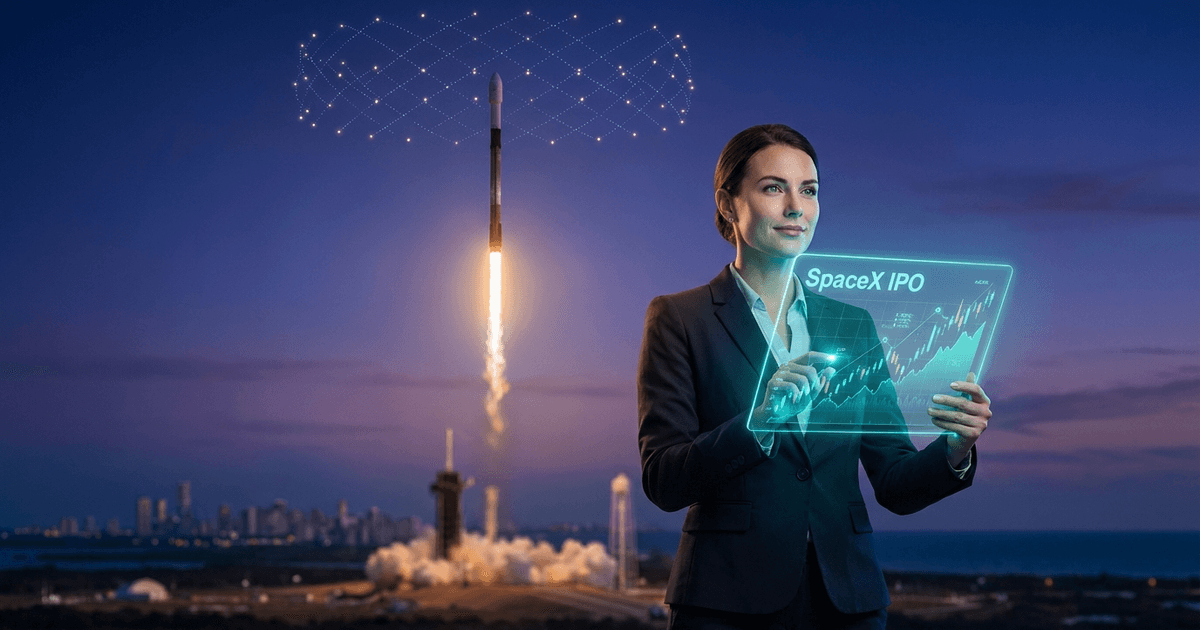
The SpaceX IPO in 2026 is not just another large-cap listing. If it happens, it will be the moment when a new kind of infrastructure company — one that bundles space transportation, global communications, and AI — finally gets priced in public markets.
And the story does not end with SpaceX alone. Jeff Bezos’s Blue Origin has filed for Project Sunrise, a plan to run AI computation in orbit. This signals a broader race to turn space itself into a computing platform. Blue Origin is not Amazon, but from an investor’s perspective, it makes sense to view the Bezos side as a combined Blue Origin / Kuiper / AWS play.
My View
The core of the SpaceX IPO is not about paying for Falcon 9’s track record. It is about how much investors are willing to pay for a vertically integrated space infrastructure vision — one that ties together Starlink, Starship, and xAI.
The strongest argument for this vision is execution. The strongest argument against it is the complexity of dependencies.
SpaceX has already demonstrated strong execution in launches, satellite communications, and government contracts. But much of its future value rests on Starship (still incomplete), xAI (still unclear on monetization), and orbital data centers (still largely conceptual). The Information has also pointed to this structural complexity as a key question for IPO participants.
Reuters reported that SpaceX has filed with the FCC for permits covering up to one million solar-powered, optical-link-based satellites as part of an “orbital data-center system.” The company’s future clearly extends beyond space transportation.
1. What Kind of Company Is SpaceX Now?
Facts
SpaceX has long been understood as a launch company. But today, its revenue center of gravity has shifted to Starlink. The Information notes that while rocket launches remain a pillar, Starlink has grown into the company’s largest revenue source.
Reuters reported that SpaceX has launched over 8,000 Starlink satellites and serves more than 5 million users across 125 countries.
In February 2026, Reuters described the SpaceX-xAI mega-merger as a vision that unites space, communications, and AI. What the market is about to evaluate is not a standalone rocket company, but a comprehensive infrastructure company trying to move communications and computing into orbit.
My View
If you look at SpaceX only as an aerospace stock, you will misread it. In investors’ minds, SpaceX has at least three faces:
First, a space transportation company with Falcon 9 and government contracts. Second, a global communications company through Starlink. Third, a computing infrastructure company via its tie-up with xAI.
If all three sit on one balance sheet, SpaceX could be priced as something like “space-based AWS + telecom + rockets.” And the larger that valuation gets, the harder it becomes for investors to define in one sentence what they are actually buying.
2. SpaceX’s Biggest Advantage Is Still Execution
Facts
SpaceX’s greatest strength right now is not its future vision — it is its current execution. According to Reuters, by the time Amazon’s Kuiper launched its first 27 operational satellites in April 2025, SpaceX had already reached its 250th Starlink-dedicated mission, with launches accelerating to more than once per week. The same article highlighted that SpaceX owns reusable Falcon 9 rockets as both a launch provider and a satellite operator — a significant structural advantage over Amazon.
Blue Origin successfully reached orbit with its New Glenn rocket in January 2025. But in terms of launch frequency, reuse track record, and constellation deployment speed, SpaceX remains well ahead. Even when Reuters reported New Glenn’s first flight, the gap in operational maturity was clear.
My View
If you look at this honestly as an investor, SpaceX’s real moat is not vision — it is the proven ability to mass-produce and operate.
In AI and semiconductors, grand visions tend to get overvalued. But in space, physics always wins in the end. No matter how ambitious the plan, very few companies can actually launch hundreds of times, update thousands of satellites, handle failures, and sustain government contracts. SpaceX has already done that.
So while the SpaceX IPO has a “buying the dream” component, it is not purely a dream stock. At the Falcon 9 and Starlink layer, there is already a solid revenue base. And it is precisely this foundation that makes the market want to stack option value — Starship and orbital data centers — on top.
There is also the Musk premium. Even when a plan looks impossibly ambitious, the market thinks “he might actually pull it off.” That belief itself is a kind of moat that competitors do not have. It is hard to quantify, but it clearly affects fundraising power and valuation expectations.
3. But the Growth Story Depends Too Heavily on Starship
Facts
The big growth scenario depends heavily on Starship. In March 2026, Reuters reported, citing a NASA Inspector General report, that Starship development has accumulated at least two years of delays relative to NASA’s lunar landing schedule, with further delays possible. A key challenge is the need for large-scale orbital refueling before a moon landing — potentially requiring 11 or more Starship launches for a single mission. NASA itself recognizes cryogenic propellant transfer as one of the most critical technical hurdles.
My View
This is the most important issue for SpaceX IPO investors. The stock’s upside potential rides on Starship, while the stable revenue base sits on Falcon 9 and Starlink.
This creates a difficult structure for investors. The near-term cash generation is relatively solid. But the dream valuation rests not on that solid part, but on the still-unproven Starship. IPO participants may end up paying for an “unproven integration vision” rather than for “mature assets” — without fully realizing it.
4. Blue Origin Is Not a “Slow SpaceX” — It Carries a Different Philosophy
Facts
In March 2026, Blue Origin filed with the FCC for Project Sunrise, proposing a space data center constellation of up to 51,600 satellites. The filing describes a non-geostationary satellite system supporting “data centers in space,” using optical inter-satellite links for data transfer.
Reuters reported that Amazon’s Project Kuiper plans a constellation of 3,236 satellites, with the first 27 launched in 2025. Amazon executives cited the advantage of connecting Kuiper to existing cloud services and consumer product experience. Amazon has signed large launch contracts with ULA, Arianespace, and Blue Origin for the Kuiper rollout.
My View
It is more useful to view Blue Origin not as a standalone space company, but as part of a broader Bezos strategy extending from the ground to space.
Musk’s approach starts from space and builds new computing infrastructure outward. Bezos’s approach, if Sunrise and Kuiper connect through AWS, would be extending the world’s strongest cloud empire directly into orbit.
This difference matters. SpaceX wants to “turn space into a computer.” The Bezos side wants to “extend the cloud into space.”
They sound similar, but from an investor’s perspective, they look quite different. Musk has the first-mover advantage, execution track record, and a bigger narrative. Bezos is slower, but if the AWS connection becomes clear, the path to revenue is easier to imagine.
In terms of scale, launch frequency, and track record, Blue Origin is not yet a direct competitor to SpaceX. But what investors should watch is not today’s gap — it is what happens when AWS’s massive customer base and computing platform extend into space.
Over the long term, this is a risk factor that cannot be ignored.
5. What Does It Mean to “Put Chips on Satellites”?
Facts
Blue Origin’s FCC filing describes Project Sunrise not as a communications constellation but as data centers in space.
Reuters also reported that SpaceX’s FCC application envisions an orbital data-center system with up to one million satellites. Both companies are moving beyond simple relay — toward embedding compute capability in orbit.
My View
This is an important shift. Traditional satellite networks were essentially “base stations in the sky.” But when we talk about “space data centers,” satellites become nodes in a distributed computer, not just relay points.
I think about this in three parts.
First, the boundary between communication and computation disappears. If pre-processing, inference, and routing optimization can happen in orbit instead of on the ground, the network itself becomes a computing resource.
Second, it bypasses ground-level bottlenecks. The practical constraints on AI infrastructure are not just GPUs — they include power, cooling, transmission, and land. I would not say space solves all of these easily, but the idea of “computing resources not bound to the ground” is a natural extension of the current AI factory discussion.
Third, whether investors classify this as a “telecom stock” or an “AI infrastructure stock” changes the valuation range entirely. If it is just Starlink, the stock gets pulled into telecom multiples. But Starlink + orbital compute + xAI tells a very different story.
6. The IPO Environment Itself May Work in SpaceX’s Favor
Facts
In March 2026, Reuters reported that the SEC is preparing a proposal to allow companies to report semi-annually instead of quarterly. This is still at the reporting stage — no official SEC comment has been made, and final action would require a formal proposal, public comment period, and vote. Reuters also noted concerns about reduced transparency and increased volatility.
The Information also covered how the burden of quarterly reporting has discouraged unicorns from going public.
My View
If this goes through, it would suit a company like SpaceX well. SpaceX is evaluated not on short-term profit stability but on long-term capital investment, R&D, and the narrative tying multiple businesses together.
Quarterly reporting is harsh on companies making large upfront investments. Less frequent reporting makes it easier for the market to sustain the narrative. That is good for long-term investors, but it also means longer periods of limited visibility.
I see both the positive and the risk here. For a company as complex as SpaceX, less frequent disclosure means investors will rely even more heavily on management’s narrative. That favors Elon Musk, but it is not necessarily safe for retail investors.
7. Three Things Investors Should Focus On
Based on everything above, I think the SpaceX IPO comes down to three questions.
① What exactly are you paying for?
Are you paying for the existing value of Falcon 9 and Starlink? Or for the option value of Starship, orbital compute, and xAI integration? Confusing the two leads to poor decisions.
② Can SpaceX maintain governance that matches its complexity?
With multiple business lines and blurry boundaries between Musk’s companies, post-IPO scrutiny on conflicts of interest, capital allocation, and talent movement will intensify. The Information has raised this as a key concern.
③ The competition is not just other rocket companies
Beyond Blue Origin, the competitive field includes Amazon’s Kuiper, government satellite programs, and terrestrial AI infrastructure companies. SpaceX’s real competitors are large players spanning telecom, cloud, defense, and AI infrastructure.
Closing Thoughts
I do not think SpaceX’s IPO should be viewed as “a big space stock listing.” It is better understood as a test: how will the market price a new kind of infrastructure company that integrates networking, computing, and transportation?
What Musk is trying to do may not be selling rockets. It may be turning space itself into the next infrastructure layer where communications and computing merge.
Meanwhile, the Bezos side may enter space as a natural extension of AWS’s terrestrial cloud dominance. This is not simply “SpaceX vs Blue Origin.” It looks more like:
- A space-native new vision vs AWS expanding into orbit
As an investor, what I find most interesting is the tension between Musk’s vision and Bezos’s strategy. I plan to keep following this closely.
Join the conversation on LinkedIn — share your thoughts and comments.
Discuss on LinkedInRelated Posts

SpaceX IPO and the Question of Valuation: How to Price Starlink's Communications Infrastructure and SpaceXAI
Stargate and SoftBank's Biggest OpenAI Bet: When a Grand AI Vision Meets Operational Reality