AI Models Are Becoming Commodities: How OpenClaw and Palantir's Ontology Point to the Agent AI OS
1. AI Model Development Is Becoming a Red Ocean
Tech companies everywhere are racing to push LLM (Large Language Model) performance higher and higher. But this competition is turning into a red ocean, and there’s a growing sense that we’re hitting a wall — high-quality training data is running out.
Against this backdrop, people like former OpenAI researcher Ilya Sutskever are calling for a paradigm shift — building systems where AI continuously learns and self-evolves, rather than relying solely on one-time pre-training.
2. What the Rise of OpenClaw Tells Us
Alongside model evolution, something else is generating a lot of excitement: free, autonomous AI agents like OpenClaw.
OpenClaw runs on your personal computer. It moves the mouse on its own, replies to emails, and handles complex tasks autonomously. Sure, giving AI full access to your machine comes with security risks, but the convenience is just too compelling for many people.
What’s even more interesting is Moltbook — a social network that came out of the OpenClaw project. It’s a space where only AI agents interact. Humans can’t participate.
I think this is deliberate. By letting AI agents interact with each other, the system creates an environment where AI can learn autonomously from those interactions. Despite the security risks, the fact that this trend is accelerating tells me there’s real momentum here — AI is moving from being a “tool” toward becoming something that grows and evolves on its own.
3. Palantir’s Ontology: Managing Autonomous AI Agents
But the more autonomous AI agents become, the bigger the challenge for organizations: how do you keep them under control and ensure safety?
That’s where the idea of an Agent AI OS comes in — something both OpenAI (with Frontier) and Palantir are working toward.
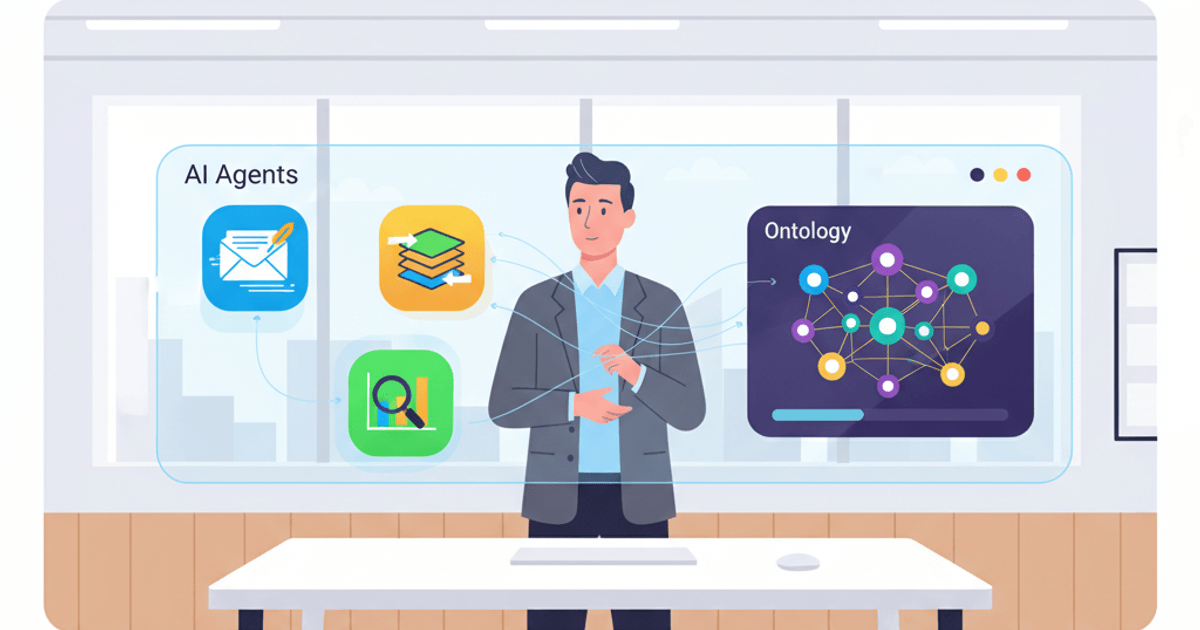
Palantir’s key concept here is the Ontology, and I think it’s going to be a critical idea in enterprise AI going forward.
What Is an Ontology?
Originally a philosophy term meaning “the study of being,” in IT an ontology is a framework for structuring the meaning and relationships between data.
Companies have data scattered across different formats and systems. An ontology organizes all of that into a common language that AI agents can understand and work with. This makes several things possible:
-
Right model for the right task: Send specific tasks to GPT, Claude, or other models depending on what they’re best at.
-
Structured instructions: When data has clear semantic meaning, AI is much less likely to hallucinate or make errors.
-
Security governance: Monitor and limit what agents can do at the OS level, making sure they stay within organizational rules.
While Microsoft and Anthropic focus on making individual agents smarter, companies like Palantir are building the AI OS — the layer that safely orchestrates and governs all those agents as a unified system.
4. Governance Can’t Be Replaced
AI agents themselves will probably become commodities over time — widely available and hard to tell apart.
But the ability to orchestrate countless agents while staying ahead in the constant cat-and-mouse game of security threats? That’s not something easily replicated.
The shift from “building smarter AI” to “building the OS that guides AI responsibly” — I believe this is the right direction for AI to truly become part of our societal infrastructure.
Join the conversation on LinkedIn — share your thoughts and comments.
Discuss on LinkedIn