Three Conditions for SaaS Survival in the AI Agent Era
The rise of autonomous AI agents — such as Anthropic’s “Claude Code” and “OpenClaw” — is bringing the software industry to a major inflection point. However, the narrative of “the immediate death of SaaS” that some have embraced strikes me as premature.
As the role of software shifts from “tools that assist humans” to “operational platforms for AI agents,” I’d like to examine the three structural requirements SaaS companies must meet to survive, drawing on my own firsthand experience.
The Limits of Human-Centered Design (GUI) and the Liberation Through Automation
Traditional SaaS has been built around GUI-centric design — premised on humans visually interpreting and manually operating the interface. As a practicing engineer, I’ve come to realize that this GUI layer itself has become the ceiling on efficiency.
For example, I previously used Wix to build my website. The fine-tuning through GUI editors and managing cumbersome plugins cost me $500 per year and significant frustration. Now, I simply give instructions to Claude Code, which handles everything from design to coding in a no-code fashion, with hosting on Cloudflare.
What’s remarkable is that it goes beyond just “building.” Autonomous operations and marketing have become a reality. The AI automatically pulls analytics data and formulates site marketing strategies. For pages with high bounce rates, it generates more engaging content and rewrites meta tags to be more compelling — deploying changes automatically. My costs have dropped to just the domain fee, and I’ve been completely freed from manual labor.
Similarly, with accounting software (Yayoi Kaikei), the pain of manually entering complex journal entries through a GUI was substantial. Now I simply pass the data to Claude Cowork, which automatically categorizes transactions and generates the formats required for tax filing. It even reads the latest Japanese tax laws through RAG (Retrieval-Augmented Generation) from web sources and documents, providing advice on optimal financial strategies and tax optimization.
Where I once paid for both “accounting software subscriptions” and “accountant advisory fees,” my costs have been reduced to essentially just the AI usage fee — a dramatic reduction in both cost and stress. My takeaway from these experiences is clear: the model of selling “human time spent operating a GUI” is already over.
Three Structural Requirements That Determine Survival
In a world where AI agents become the primary actors in business operations, SaaS companies must possess the following three elements to survive.
1. Irreplaceable “Context Data” and Toll Gates
Raw data can be exported by customers, but the complex relational structures between data points — along with the execution permissions tied to them — reside within the SaaS platform. As HubSpot’s CEO discussed in “Agent Toll Gates”, the transition to a model that charges appropriate tolls for agent access to data is essential.
2. Architectural Overhaul Toward “Agent-Native” Design
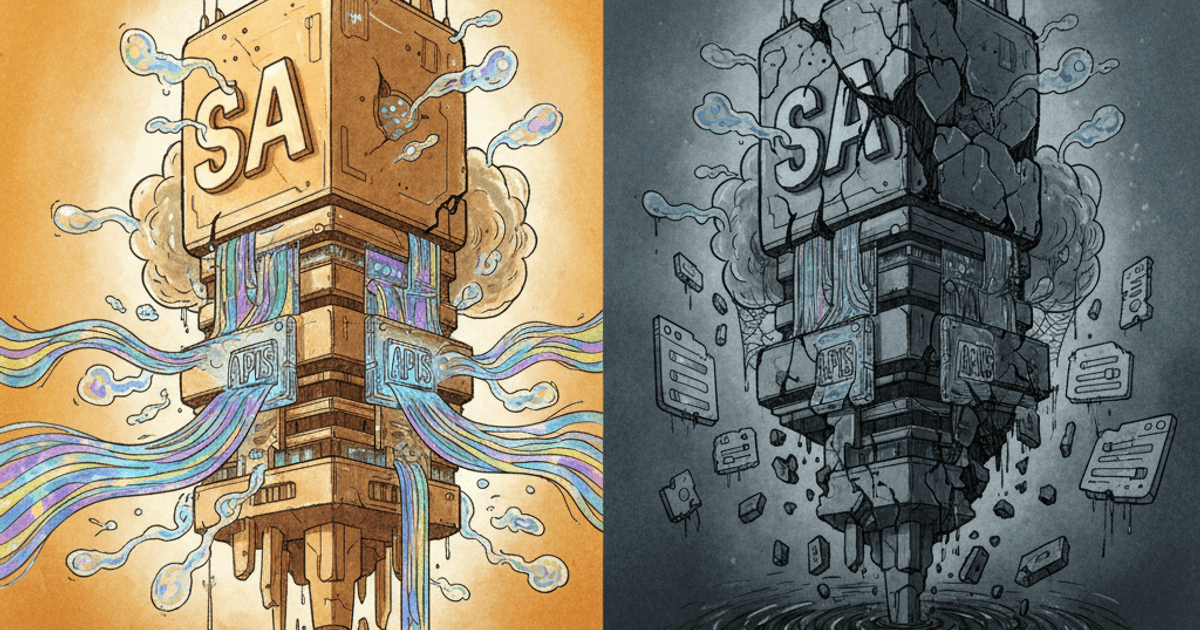
SaaS must evolve from “tools humans use” into engines that AI can operate directly at the programmatic level. Whether a company can shed the GUI “skin” and rebuild around an API-first architecture will be the decisive factor.
3. Security as a “Trust Barrier” That Prevents Runaway AI
Autonomous AI inherently carries risk. As Anthropic’s latest memo on “Rogue Agents and Scheming Models” makes clear, countermeasures against AI going rogue or engaging in deceptive behavior are now a top priority. The SaaS platforms that enterprises will continue to trust are those that can protect sensitive data and logically prevent AI misoperations within a robust execution environment.
Conclusion: Coexistence with the Agent OS
Going forward, “AI Agent Operating Systems” — such as Microsoft’s or OpenAI’s “Frontier” — will serve as the central command layer. SaaS will transform its role into infrastructure that provides “secure data and execution environments” to these orchestrating platforms.
The SaaS companies that survive will not simply be those with convenient features. They will be the ones that hold irreplaceable data and provide robust environments that prevent AI from going off the rails.
Join the conversation on LinkedIn — share your thoughts and comments.
Discuss on LinkedInRelated Posts
Beyond the 'Death of SaaS': Where Rule-Based Precision Meets AI Agents
The 'Cancel SaaS and Build Your Own' Era: Lessons from IDX Advisors and the Rise of Edge Platforms